
Bell Street Hall poster, 29 and 31 August 1846
Poster
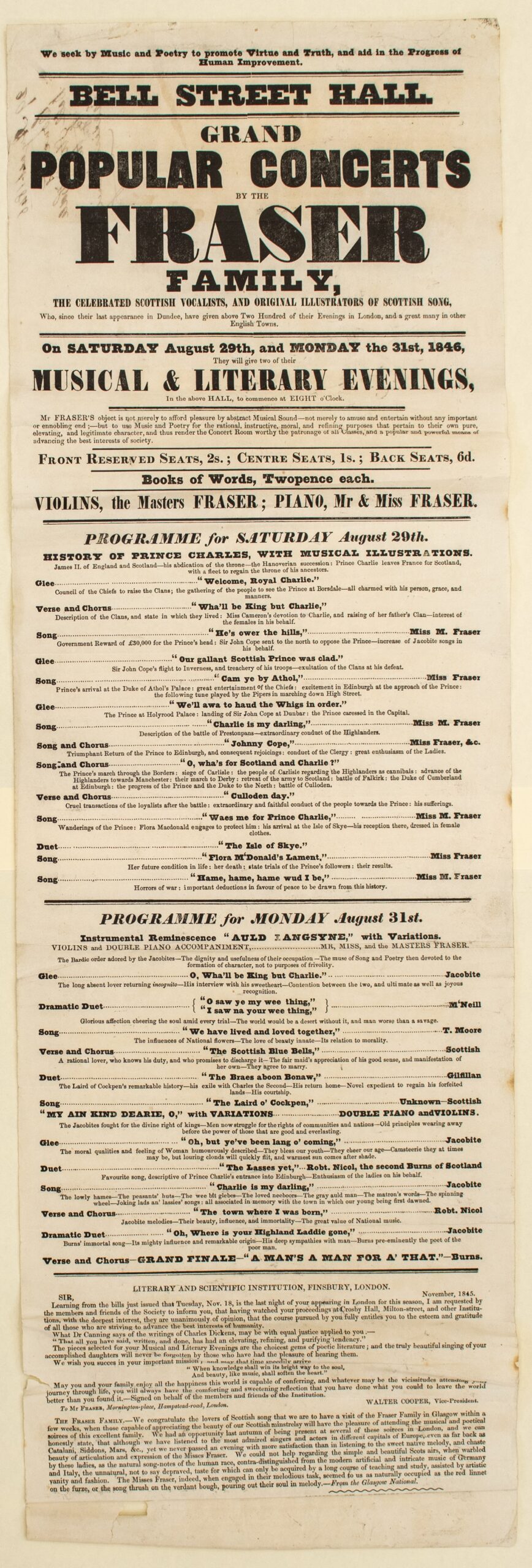
This poster advertises two musical and literary evenings presented by the Fraser Family, a touring troupe of singers and instrumentalists. Featuring songs, recitations, violin and piano performances, and comic entertainment.
Object details
- Object type
- Poster
- Production date
- Aug 1846
- Dimensions
- 21.5 x 67.0 cm
- Museum number
- MH/BSH/08
Source collection
Local History Centre Poster Collection, Dundee Central Library
The object’s story
Transcription
We seek by Music and Poetry to promote Virtue and Truth, and aid in the Progress of Human Improvement.
BELL STREET HALL
GRAND
POPULAR CONCERTS
BY THE
FRASER FAMILY,
THE CELEBRATED SCOTTISH VOCALISTS, AND ORIGINAL ILLUSTRATORS OF SCOTTISH SONG,
Who, since their last appearance in Dundee, have given above Two Hundred of their Evenings in London, and a great many in other English Towns.
On SATURDAY August 29th, and MONDAY the 31st, 1846,
They will give two of their
MUSICAL & LITERARY EVENINGS,
In the above HALL, to commence at EIGHT o’Clock.
Mr FRASER’S object is not merely to afford pleasure by selected Musical Sound, not merely to amuse and entertain without any important or ennobling end; but to use Music and Poetry for the national, instructive, moral, and refining purposes that pertain to their own pure, elevating, and legitimate character, and thus render the Concert Room worthy the patronage of all classes, and a popular and powerful means of advancing the best interests of society.
FRONT RESERVED SEATS, 2s.; CENTRE SEATS, 1s.; BACK SEATS, 6d.
Books of Words, Twopence each.
VIOLINS, the Masters FRASER; PIANO, Mr & Miss FRASER.
PROGRAMME for SATURDAY August 29th.
HISTORY OF PRINCE CHARLES, WITH MUSICAL ILLUSTRATIONS.
James II. of England and Scotland – his abdication of the throne – the Hanoverian succession: Prince Charlie leaves France for Scotland, with a fleet to regain the throne of his ancestors.
Glee … “Welcome, Royal Charlie”
Council of the Chiefs to raise the Clans; the gathering of the people to see the Prince at Borsdale – all charmed with his person, grace, and manners
Voice and Chorus … “Wha’ll be King but Charlie?”
Description of the Clans, and state in which they lived: Miss Cameron’s devotion to Charlie, and raising of her father’s Clan – interest of the females in his behalf.
Song … “Ye owe’r the hills” … Miss M. Fraser
Government Reward of £30,000 for the Prince’s head: Sir John Cope sent to the north to oppose the Prince – increase of Jacobite songs in his behalf.
Glee … “Our gallant Scottish Prince was clad”
Sir John Cope’s flight to Inverness, and treachery of his troops – exultation of the Clans at his defeat.
Song … “Cam ye by Athol?” … Miss Fraser
Prince’s arrival at the Duke of Athol’s Palace: great entertainment of the Chiefs: excitement in Edinburgh at the approach of the Prince: the following tune played by the Pipers in marching down High Street.
Glee … “We’ll awa to haud the Whigs in order”
The Prince at Holyrood Palace: landing of Sir John Cope at Dunbar: the Prince caressed in the Capital.
Song … “Charlie is my darling” … Miss M. Fraser
Description of the battle of Prestonpans – extraordinary conduct of the Highlands.
Song and Chorus … “Johnny Cope” … Miss Fraser, &c.
Triumphant Return of the Prince to Edinburgh, and consequent rejoicings: conduct of the Clergy: great enthusiasm of the Ladies.
Song and Chorus … “O, wha’s for Scotland and Charlie?”
The Prince’s march through the Borders: siege of Carlisle: the people of Carlisle regarding the Highlanders as cannibals: advance of the Highlanders towards Manchester: their march to Derby: retreat of the army to Scotland: battle of Falkirk: the Duke of Cumberland at Edinburgh: the progress of the Prince and the Duke to the North: battle of Culloden.
Verse and Chorus … “Culloden day”
Cruel transactions of the loyalists after the battle: extraordinary and faithful conduct of the people towards the Prince: his sufferings.
Song … “Waes me for Prince Charlie” … Miss M. Fraser
Wanderings of the Prince: Flora Macdonald engages to protect him: his arrival at the Isle of Skye – his reception there, dressed in female clothes.
Duet … “The Isle of Skye”
Song … “Flora McDonald’s Lament” … Miss Fraser
Her future condition in life: her death: state trials of the Prince’s followers: their results.
Song … “Hame, hame, hame ould I be” … Miss M. Fraser
Horrors of war: important deductions in favour of peace to be drawn from this history.
PROGRAMME for MONDAY August 31st.
Instrumental Reminiscence “AULD LANG SYNE,” with Variations.
VIOLINS and DOUBLE PIANO ACCOMPANIMENT … Mr, Miss, and the Masters Fraser
The Bardic order adored by the Jacobites – The dignity and usefulness of their occupation – The muse of Song and Poetry then devoted to the formation of character, not to purposes of frivolity.
Glee … “O, Wha’ll be King but Charlie?” … Jacobite
The long absent lover returning incognito – His interview with this sweetheart – Contention between the two, and ultimate as well as joyous recognition.
Dramatic Duet … “O saw ye my wee thing” / “I saw na your wee thing” … M’Neill
Glorious affection cheering the soul amid every trial – The world would be a desert without it, and man worse than a savage.
Song … “We have lived and loved together” … T. Moore
The influences of National flowers – the love of beauty innate – Its relation to morality
Verse and Chorus … “The Scottish Blue Bells” … Scottish
A rational lover, who knows his duty, and who promises to discharge it – The fair maid’s appreciation of his good sense, and manifestation of her own – They agree to marry.
Duet … “The Braes aboon Bonaw” … Gilfillan
The Laird of Cockpen’s remarkable history – his exile with Charles the Second – His return home – Novel expedient to regain his forfeited lands – His courtship.
Song … “The Laird o’ Cockpen” … Unknown – Scottish
“MY AIN KIND DEARIE, O,” with variations … Double Piano and Violins
The Jacobites fought for teh divine right of kings – Men now struggle for the rights of communities and nations – Old principles wearing away before the power of those that are good and everlasting.
Glee … “Oh, but ye’ve been lang o’ coming” … Jacobite
The moral qualities and feeling of Woman humourously described – They bless our youth – They cheer our age – Camsteerie they at times may be, but louring clouds will quickly flit, and warmest sun comes after shade.
Duet … “The Lassie yet” … Robt. Nicol, the second Burns of Scotland
Favourite song, descriptive of Prince Charlie’s entrance to Edinburgh – Enthusiasm of the ladies on his behalf.
Song … “Charlie is my darling” … Jacobite
The lowly hames – The peasants’ huts – The wee bit glebes – The loved neebors – The gray auld man – The Matron’s words – The spinning wheel – Joking lads an’ lassies’ songs: all associated in memory with the town in which our young being first dawned.
Verse and Chorus … “The town where I was born” …Robt. Nicol
Jacobite melodies – Their beauty, influence, and immortality – The great value of National music.
Dramatic Duet … “Oh, Where is your Highland Laddie gone” … Jacobite
Burns’ immortal song – Its mighty influence and remarkable origin – His deep sympathies with man – Burns pre-eminently the poet of the poor man.
Verse and Chorus – GRAND FINALE – “A MAN’S A MAN FOR A’ THAT.” — Burns
LITERARY AND SCIENTIFIC INSTITUTION, FINSBURY, LONDON
LITERARY AND SCIENTIFIC INSTITUTION, FINSBURY, LONDON.
November, 1845.
SIR,
Learning from the bills just issued that Tuesday, Nov. 18, is the last night of your appearing in London for this season, I am requested by the members and friends of the Society to inform you, that having watched your proceedings at Crosby Hall, Milton-street, and other Institutions, with the deepest interest, they are unanimously of opinion, that the course pursued by you fully entitles you to the esteem and gratitude of all those who are striving to advance the best interests of humanity.
What Dr Canning says of the writings of Charles Dickens, may be with equal justice applied to you;—
“That all you have said, written, and done, has had an elevating, refining, and purifying tendency.”
The pieces selected for your Musical and Literary Evenings are the choicest gems of poetic literature; and the truly beautiful singing of your accomplished daughters will never be forgotten by those who have had the pleasure of hearing them.
We wish you success in your important mission, and may that time speedily arrive,
“When knowledge shall win its bright way to the soul,
And beauty, like music, shall soften the heart.”
May you and your family enjoy all the happiness this world is capable of conferring, and whatever may be the vicissitudes attending your journey through life, you will always have the comforting and sweetening reflection that you have done what you could to leave the world better than you found it.—Signed on behalf of the members and friends of the Institution.
WALTER COOPER, Vice-President.
To Mr Fraser, Mornington-place, Hampstead-road, London.
THE FRASER FAMILY.
We congratulate the lovers of Scottish song that we are to have a visit of the Fraser Family in Glasgow within a few weeks, when those capable of appreciating the beauty of our Scottish minstrelsy will have the pleasure of attending the musical and poetical soirees of this excellent family.
We had an opportunity last autumn of being present at several of these soirées in London, and we can honestly state, that although we have listened to the most admired singers and actors in different capitals of Europe, even as far back as Catalani, Siddons, Mars, &c., yet we never passed an evening with more satisfaction than in listening to the sweet native melody, and chaste beauty of articulation and expression of the Misses Fraser.
We could not help regarding the simple and beautiful Scots airs, when warbled by these ladies, as the natural song-notes of the human race, contra-distinguished from the modern artificial and intricate music of Germany and Italy, the unnatural, not to say depraved, taste for which can only be acquired by a long course of teaching and study, assisted by artistic vanity and fashion.
The Misses Fraser, indeed, when engaged in their melodious task, seemed to us as naturally occupied as the red linnet on the furze, or the song thrush on the verdant bough, pouring out their soul in melody.
—From the Glasgow National.