Map coordinates: 1054.0636613322, 2322.5551305223
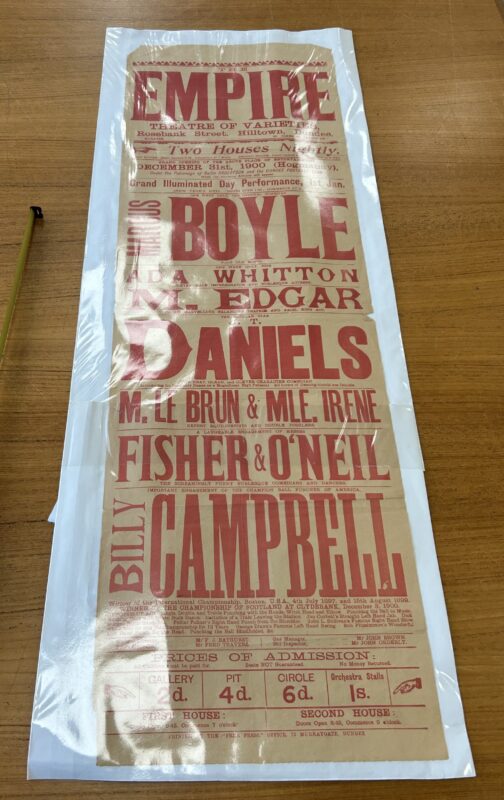
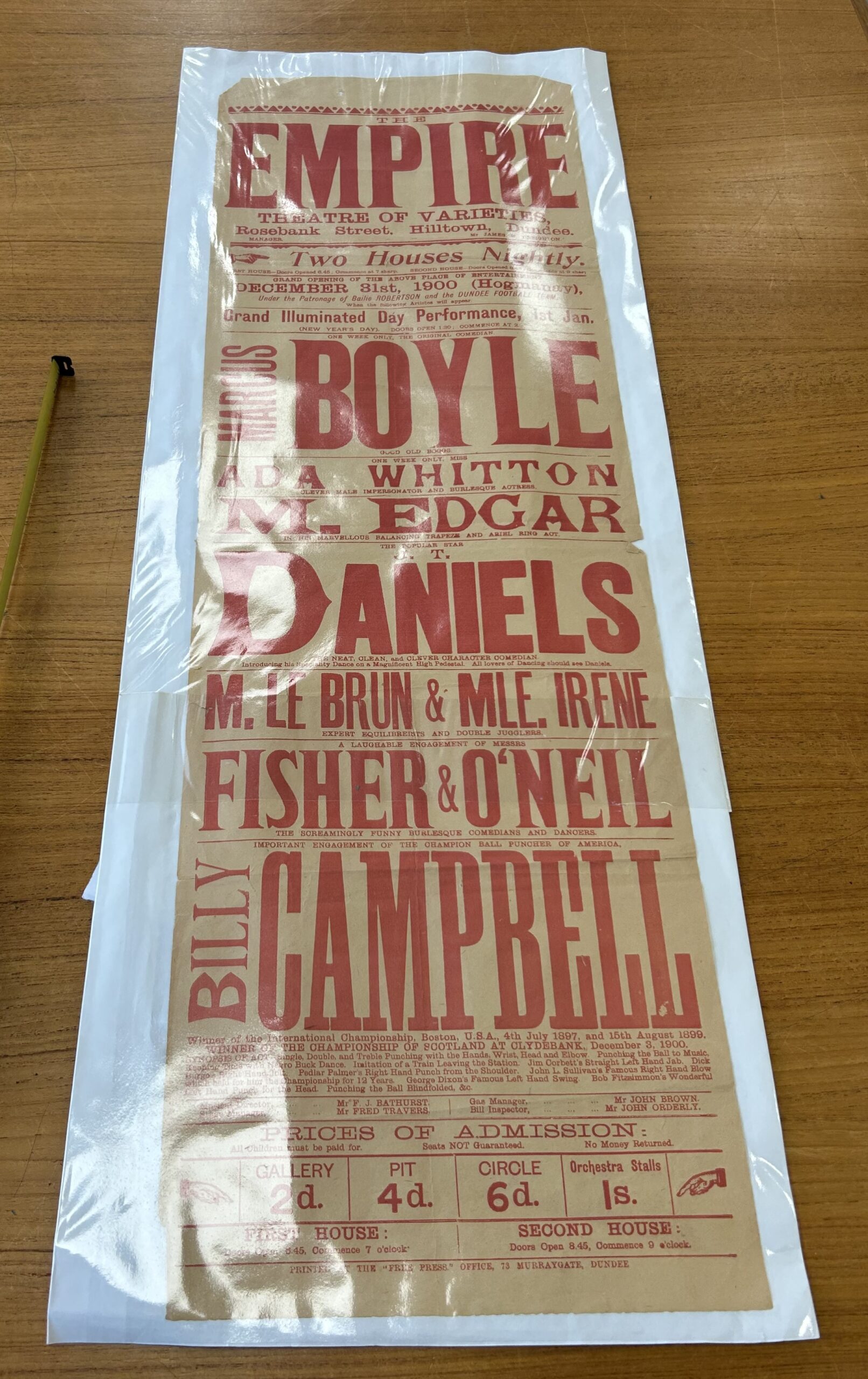
Originally built in stone and line, with a corrugated iron roof, 100 feet in length, 47 feet in breadth and 50 feet in height, The Empire Theatre of Varieties stood towards the north of Dundee city centre. The stage was “24 feet wide, and from 20 to 26 feet deep, thus giving ample room to stage any large scene sketch.” (‘New Variety Theatre for Dundee’, The Courier & Argus, 28 December 1900, p.5). Four boxes were fitted close to the stage, with seating upholstered in traditional red plush.
The building took six weeks to construct, from laying its first brick to being open – in fact, “so good was the all-round progress made that the balcony was up before the roof was on…” (‘New Variety Theatre for Dundee’, The Courier & Argus, 28 December 1900, p.5)
In terms of his management, J.M. Creighton operated on the two-house principle, whist essentially saw the programme performed twice in the same evening.
The Empire welcomed a true variety of performers to its stage, including ‘Madame Raftin’s Performing Monkeys’ (October 1902),
‘Miss Reinree Elepier’s Company of Irish Players) (January 1903), as well as an evening of Mitchell & Belton’s Popular Dramatic Company in “THE GREATEST OF ALL PRISON DRAMAS – SECRETS OF THE POLICE”, which was accompanied by a grand weight-lifting competition and “Sweer – Tree Competition” (a game where two players sit on the ground facing each other, press the soles of their feet together, grip a stick between them, and pull until one player manages to lift the other off the ground) which came with the first prize of a “Magnificent Silver Cup”. (‘Empire Theatre’, The Courier & Argus, 16 November 1904, p.1)
By 1905 the hall had been rebranded as ‘The Empire Theatre’ and focused more on theatre performances and concerts. Film screenings were also proving more profitable. In February 1906, for example, the theatre advertised a “SACRED PICTURE CONCERT, …. By Western Canadian Animated Picture Company” (‘Sacred Picture Concert’, The Courier & Argus, 3 February, p.1)
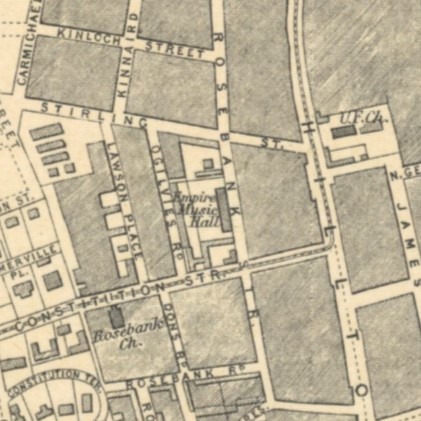
In July 1914 the building was destroyed by fire. This saw an end to its music hall history (although it was still identified as the “Empire Music Hall” on James Thomson’s 1915 town plan of the city). In 1914 a new theatre rose from its ashes – the Empire Theatre – and by 1920 it was staging concerts and film screenings. The cinema eventually closed in 1957 and the building demolished in the early 1960s.