
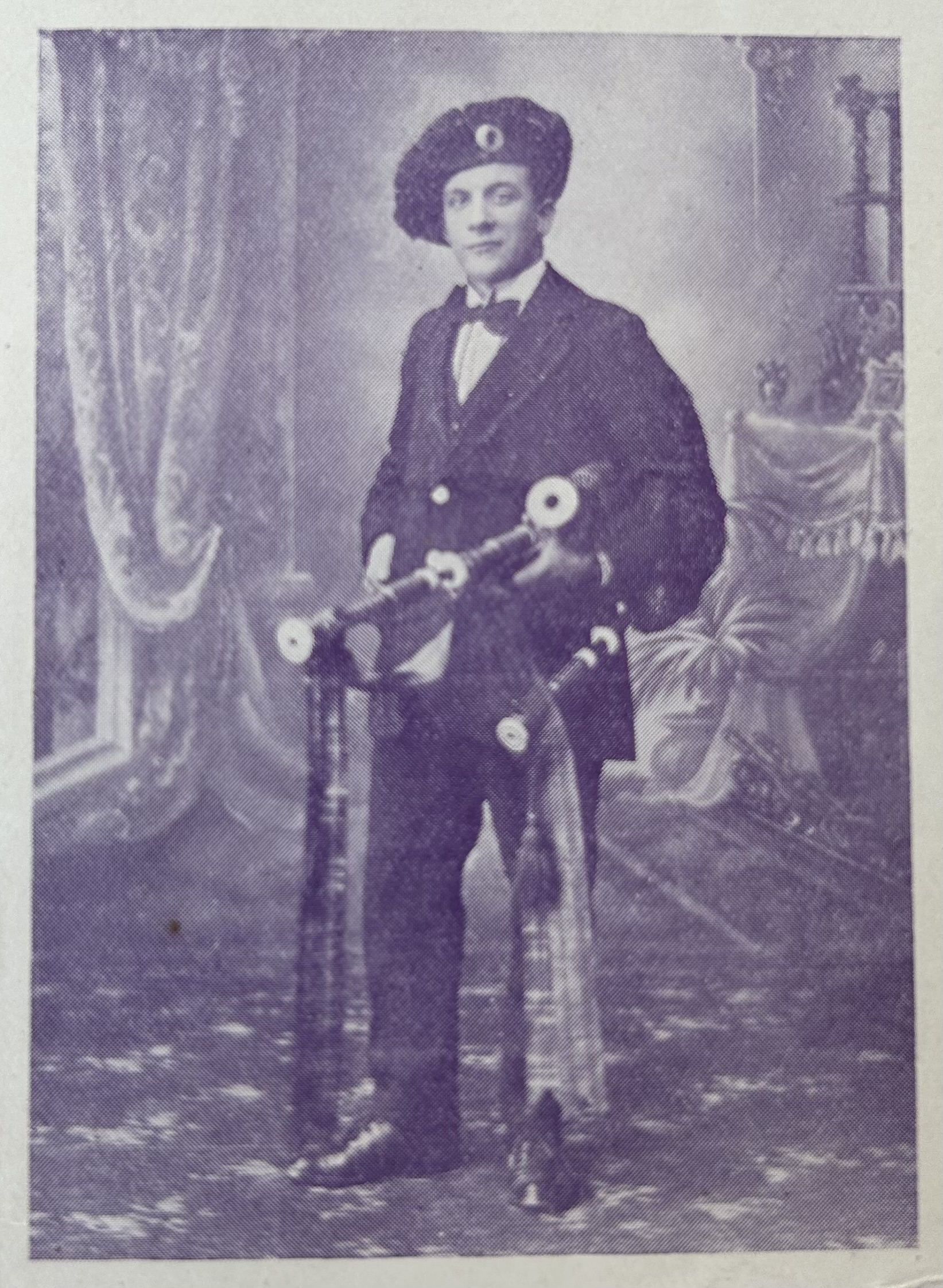
George ‘Geordie’ Lackie (1886–1947) was a Dundee character comedian who performed regularly in and around the city during the first few decades of the twentieth century. Although largely forgotten today, his story tells us much about the touring life of a Scottish performer during this period, particularly through a remarkable collection of ephemera held by the Local History Centre at Dundee Central Library.
George Alexander Lackie was born in the city’s William Street in April 1886. Little is known about his early performing career, but by 1908 he was certainly performing a Harry Lauder skit: ‘Mr George Lackie gave an excellent impersonation of Harry Lauder’.[i] Based on his own advertising material, Lackie’s act focused on comic songs accompanied by the bagpipes. During the Great War, Lackie served in the Argyll and Sutherland Highlanders. He was wounded in service in spring 1918:
His many friends will regret to learn that Private George Lackie, A. and S. Highlanders, a well-known Scottish comedian in Dundee, has been seriously wounded. “Geordie,” as he was familiarly known, previously resided at 7 Balmore Street, Dundee, and was well known in the city, especially in junior football circles, having captained the East Craigie F.C. for several seasons. He enlisted last year and had been at the front for three or four months. Prior to enlisting he was employed in a munition work in the city.[ii]
Lackie returned to performing after his military service, appearing regularly throughout Dundee and the surrounding area during the 1920s and 1930s.
Lackie is a typical example of the largely itinerant and locally based performers who formed an important part of Scotland’s popular entertainment culture in the early twentieth century. What makes his story particularly valuable is the surviving materialof several postcards and notes written on envelopes relating to his career. These sources provide a rare glimpse into the working life, publicity, and local networks of a Dundee performer, as well as the wider touring circuits through which Scottish entertainers made their living.
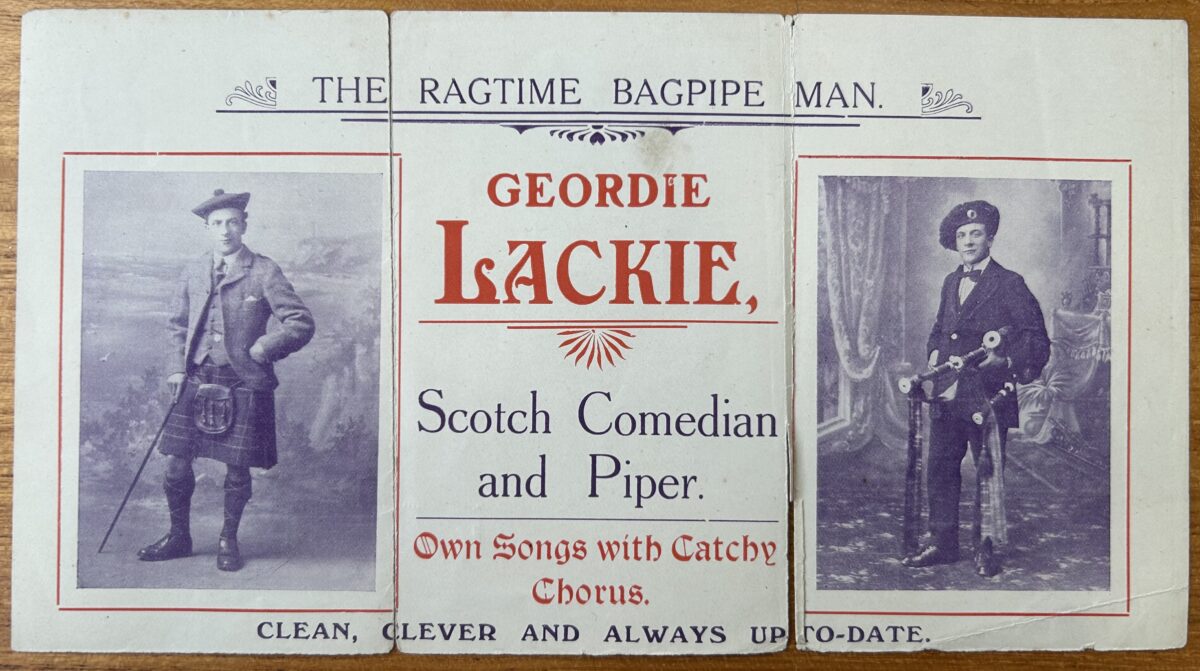
The notes date from December 1913 through to early July 1915 and were donated by Gwen Whyte, who inherited them from her late aunt, who had been a neighbour of Lackie’s in Dundee’s Balmore Street. Accompanying the collection is a promotional leaflet billing Lackie as ‘The Ragtime Bagpipe Man’. The leaflet features Lackie in Highland dress and promotes his act as ‘clean, clever and always up-to-date.’ It is clear that Harry Lauder still heavily influenced Lackie’s performances and reflects Lauder’s wider popularity at the time. One of the most famous entertainers of the early twentieth century, Lauder was also among the highest-paid performers in the world. He was one of the first British recording artists to sell more than a million records, and his success inspired many Scottish comedians, singers, and variety performers who followed in his footsteps.
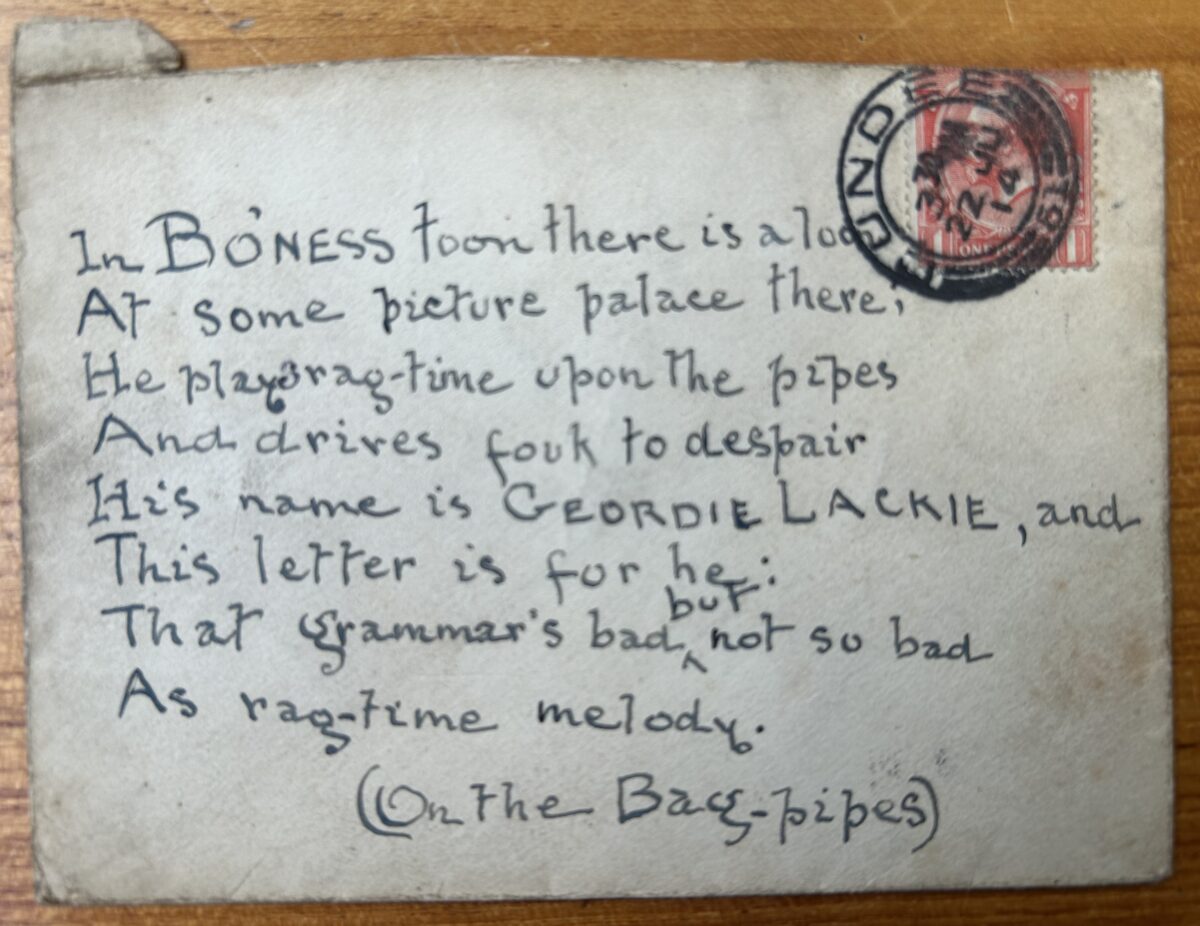
For Lackie, the world was not quite on his footstep. As a local, part-time, professional comedian the furthest the existing notes were sent to was Aberdeen and Glasgow, but it is clear Lackie’s performing schedule was busy during 1913-15. Locations mentioned include Dundee (Oxford), and Edinburgh (Tivoli) and Glasgow (Casino, Gaiety, Garrity’s, The Star, Queens) of course, but Lackie clearly travelled widely across Scotland performing his act, including: Bo’ness, Broxburn (Picturedrome), Cowdenbeath (Empire), Forfar (Palace), Grangemouth (Picture Palace), Linlithgow (Scott’s Pictures), Methil (Gaiety Theatre), Montrose (Palace), Mossend (Pavilion), Musselburgh (Empire), Peterhead (Clark’s Picture Palace), Penicuik (Pavillion), and Saltcoats (Pavilion). Some of these buildings, such as the Gaiety and Picture Palace in Glasgow are still extant but most are now demolished. Tellingly the majority of venues also operated as cinemas, highlighting the popularity of film screenings over more traditional music hall acts.
In terms of his performance, the notes provide a clue to what audiences would expect from Lackie. Written in verse, “comic airs” and “bagpipe melodies” are mentioned (George Lackie envelope note, 23 March 1914, page 1) as is, in Musselburgh:
At a strathspey, pibroch, slogan,
George Lackie envelope note, 08 April 1914, page 1. Local History Centre Poster Collection, Dundee Central Library.
At a Hielant mairch, or reel,
Or ony rag-time number:
Wi’ his bag-pipes he’s a de’il
Not every note is complimentary though, and there was clearly an affectionate ribbing between sender and recipient:
Or even the note to the people of Methil:
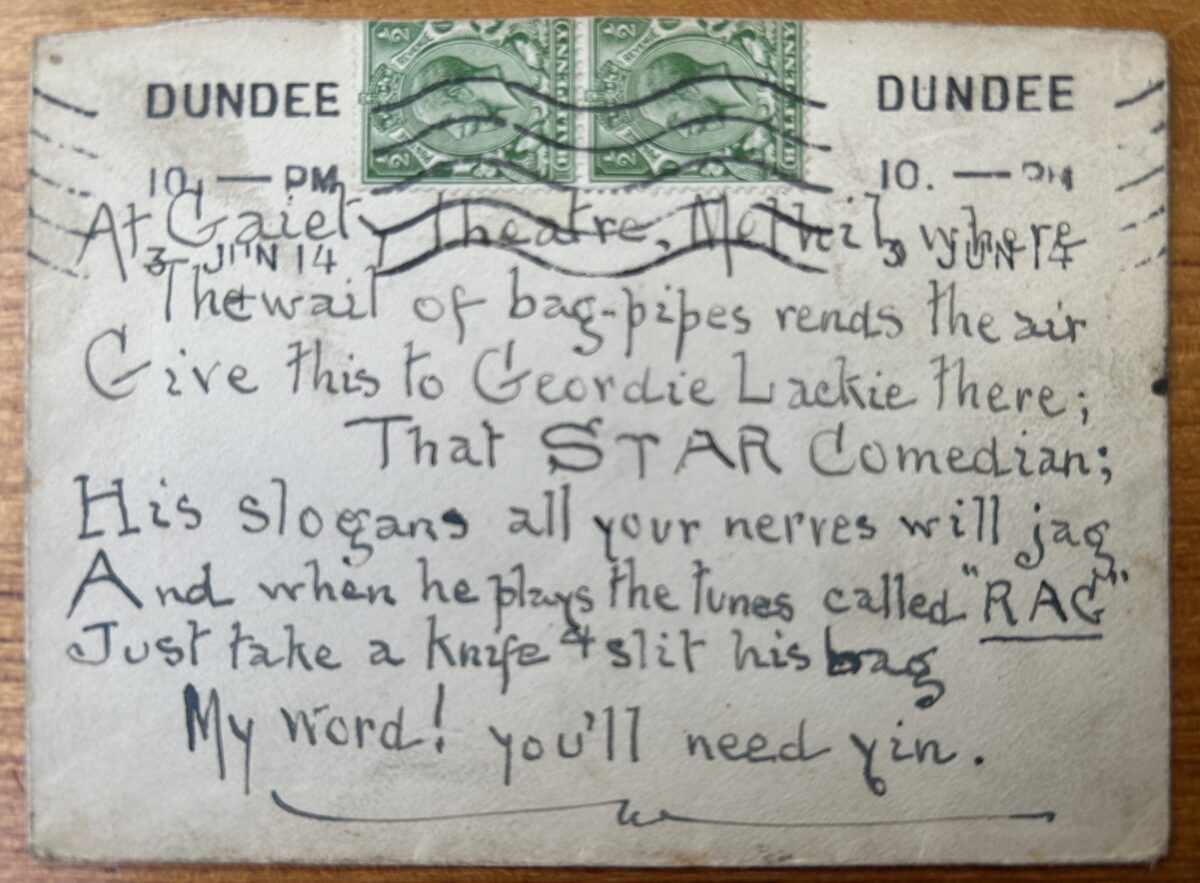
But, generally, the writer is complementary on their friend’s talent. “That bagpipe squeezing star” notes the author (George Lackie envelope note, 24 April 1914) who played “bagpipes to the million” (George Lackie envelope note, 27 May 1914).
Lackie performed in Dundee, of course, at both the Oxford on Logie Road (January 1914) and the King’s Theatre (September 1914). At the Oxford the letter writer noted Lackie’s preference for a kilt whilst performing and even mentions a song Lackie may have performed:
This letter please convey
George Lackie envelope note, 29 January 1914. Local History Centre Poster Collection, Dundee Central Library.
Where NOBLE nobly caters
For the people out that way
On the LOCHEE Rd it standeth
Where LACKIE is they say
Making strides in a kilt
And singing a lilt
Called, “Tooral-ay-ooral-ay-aye.
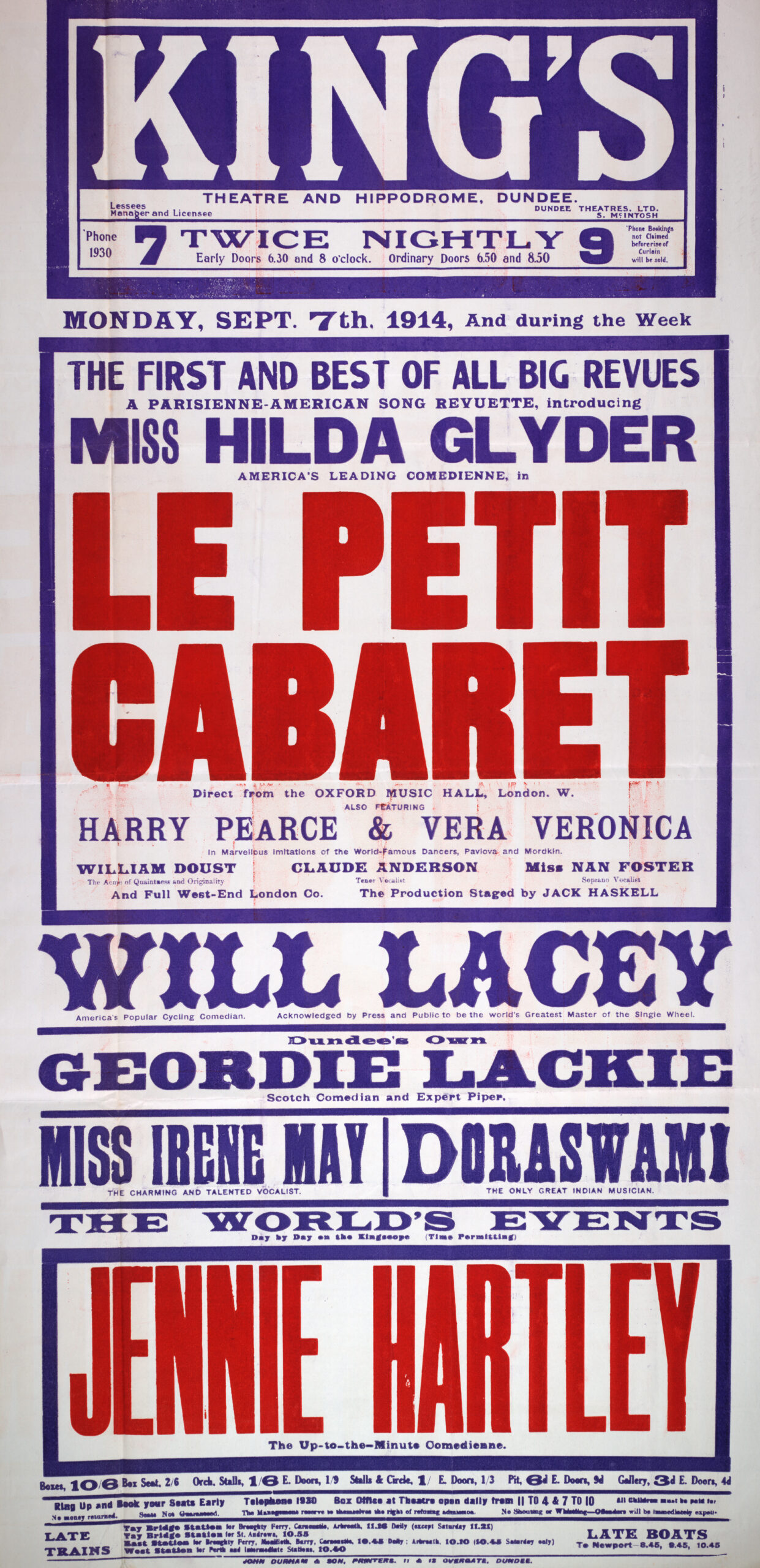
Whilst at the King’s he was also featured on the venue’s poster, billed as ‘Dundee’s Own – Geordie Lackie – Scotch Comedian and Expert Piper’.
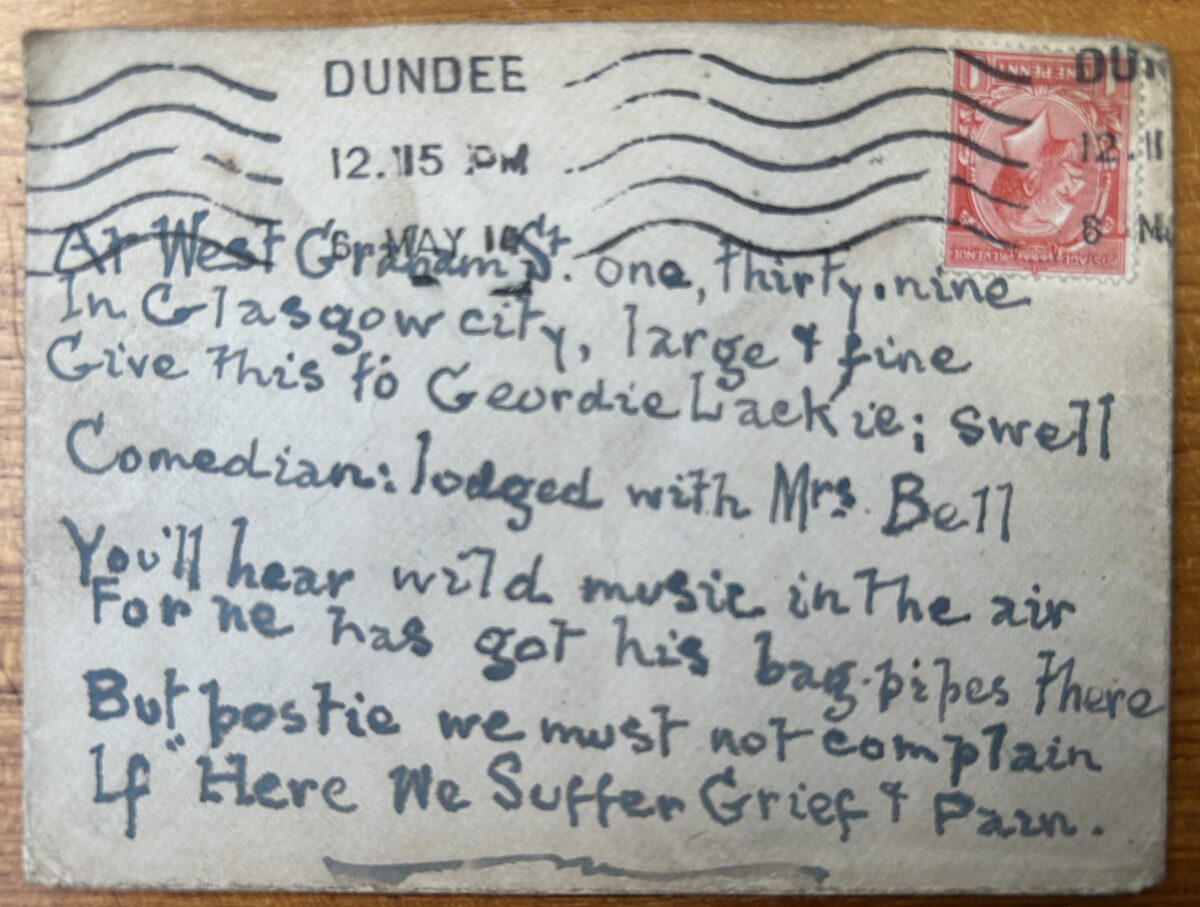
His lodging in Glasgow is mentioned too (Mrs Bell’s, 139 West Graham Street) where the postman was warned:
You’ll hear wild music in the air
For he has got his bag-pipes there
But postie we must not complain
If there we suffer grief & pain.
By the 1940s, however, Lackie’s performing career seems to have faded. In March 1947, he died at the age of just 60. His death certificate records his address as 293 Strathmore Avenue, Dundee, and gives his occupation as a ‘commercial traveller’ – a reminder that a career in performance could be fickle and often had to be supplemented by other means. Yet, the notes provide an invaluable record of the venues, type of entertainment, and touring life of a Scottish performer during this period.
Dr Billy Rough, School of Art History, University of St Andrews, 2026
[i] ‘St Andrews’, The Courier & Argus, 30 March 1908, p.3.
[ii] The Courier & Argus, 3 April 1918, p.3.