
In the printed culture of Dundee’s 19th-century music hall and theatre posters, one name stands above all others: J. Durham & Son. Operating in the city from 1835 until 1972, the firm became one of Dundee’s most enduring and influential printworks, leaving behind a remarkable visual record of changing styles in commercial and theatrical design across more than a century.[1] The playbills, posters, and programmes preserved in Dundee’s Local History Centre, and dating from the 1860s to the early 20th century, reveal the extent of the company’s dominance, with the vast majority of performance-related material bearing the imprint of J. Durham & Son.
Durham & Son were based in several locations in the city through their lifetime. The base of his early Dundee operations is uncertain but in 1837 Durham’s was based at 27 Reform Street, and by 1842 and until 1846 the firm was operating from 67 High Street.[2] By 1846 the firm had relocated to 49 High Street, Dundee, where they would remain until 1911. In 1869 Durham also began operations at 13 Overgate and the business would be based at both locations until 1910 when the firm resigned their High Street property and extended into 11 and 19 Overgate. 11, 13 and 19 Overgate would house Durham & Son until 1962 when the redevelopment of the Overgate forced the firm to relocate to 5 Constitution Road. Durham & Son would remain in Constitution Road until their closure in 1972. In this short piece we’ll look at some of the material produced by Durham & Son during their 136-year history with a focus on music hall posters dating from 1860s through to the early 20th century; the glory days of the halls.
John Durham & Son: Early Days (1835-1877)
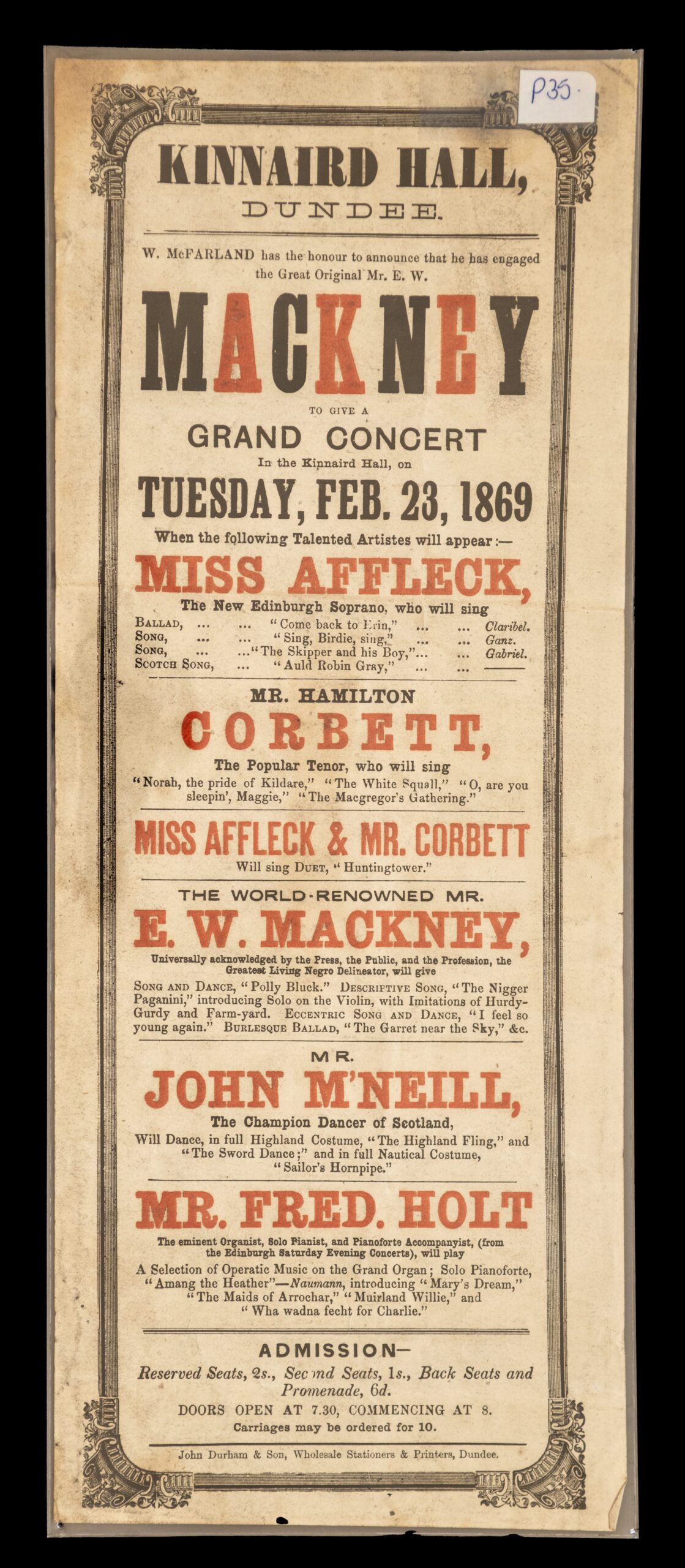
John Durham was born near Edinburgh on 6 December 1802 to Isobella (née Murray) and John Durham, a ‘gentleman’s servant’.[3] There is little known about the younger Durham’s early training but, by 1835, he had relocated to Dundee where he promptly established a stationery business.[4] The business developed over the 1830s, through to the 1860s, and included the services of printing, bookbinding, booksellers, and even paper bag manufacturing. By the 1860s the business was firmly established as a printer, and an example of their work can be seen in their 1869 playbill for William McFarland’s Grand Concert at the Kinnaird Hall. Durham’s design is a bold one, making strong use of colour contrasts of black and red – particularly so in the alternating lettering for ‘MACKNEY’ – and incorporating a decorative ornamental border. The Kinnaird playbill proved eye catching and a design that, no doubt, pleased McFarland as he would utilise Durham’s services for several years to come.
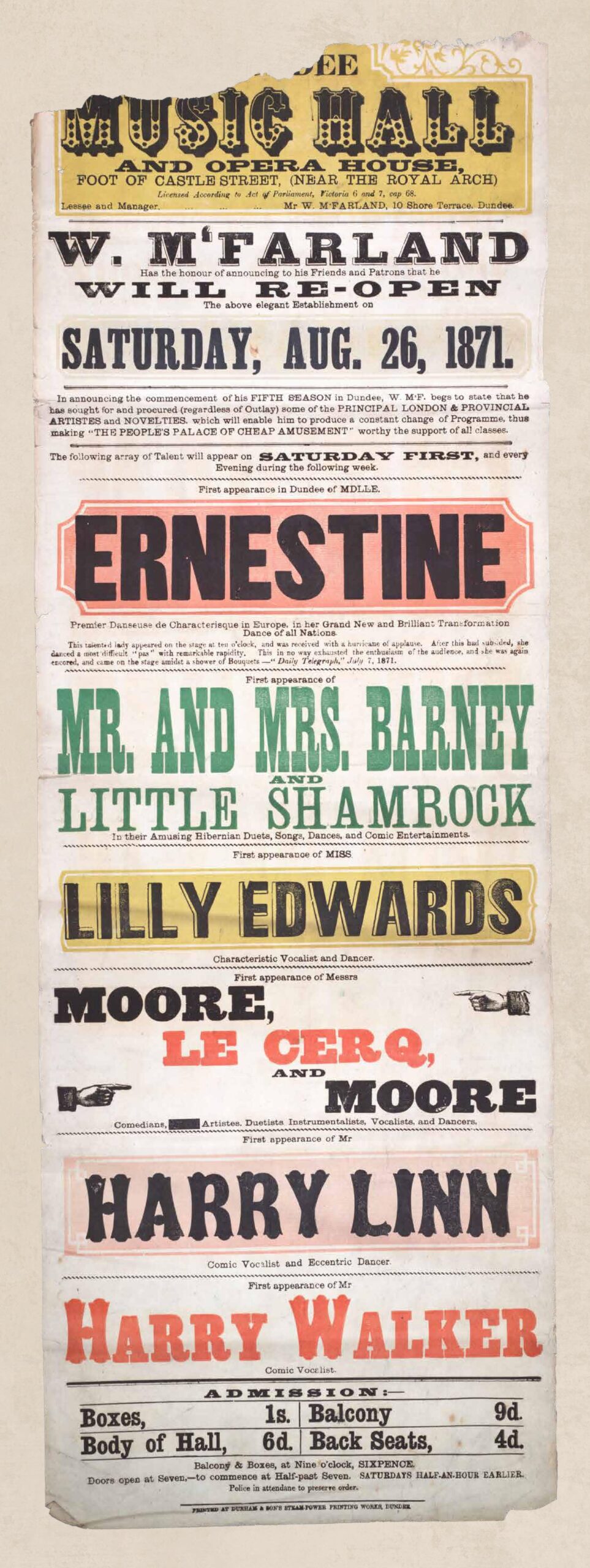
McFarland would engage Durham & Son throughout the 1870s and 80s. A particularly effective design by the company can be seen in their 1871 poster for McFarland’s Dundee Music Hall and Opera House. Much bolder than the 1869 Kinnaird Hall poster, this design makes far greater use of colour and varied typography, demonstrating that Durham & Son were actively engaged with contemporary developments in print design. The inclusion of two manicules – illustrated pointing hands commonly used in music hall advertising of the period – further reflects the firm’s awareness of modern visual trends.
It is a carefully considered and highly dynamic composition. While clearly designed to capture the viewer’s attention, the poster never feels excessively crowded or chaotic. Of note is Durham’s statement that the poster was produced at their ‘steam-power printing works,’ a detail that not only advertised the firm’s technical capabilities but also reflected the wider evolution of Victorian commercial printing towards increasingly bold, eye-catching, and competitive graphic design.
The James Durham Years (1877-1905)
On 26 January 1877, John Durham died at the age of 74 at his home at Wingate Place (10 Tay Street) Newport-on-Tay. Following his death, his son, James, who was already a partner, took over the business. At this time, John Kinnoch, who had been employed by the company for several years, was also appointed a partner and the firm was subsequently sometimes identified as J. Durham, Son & Kinnoch.
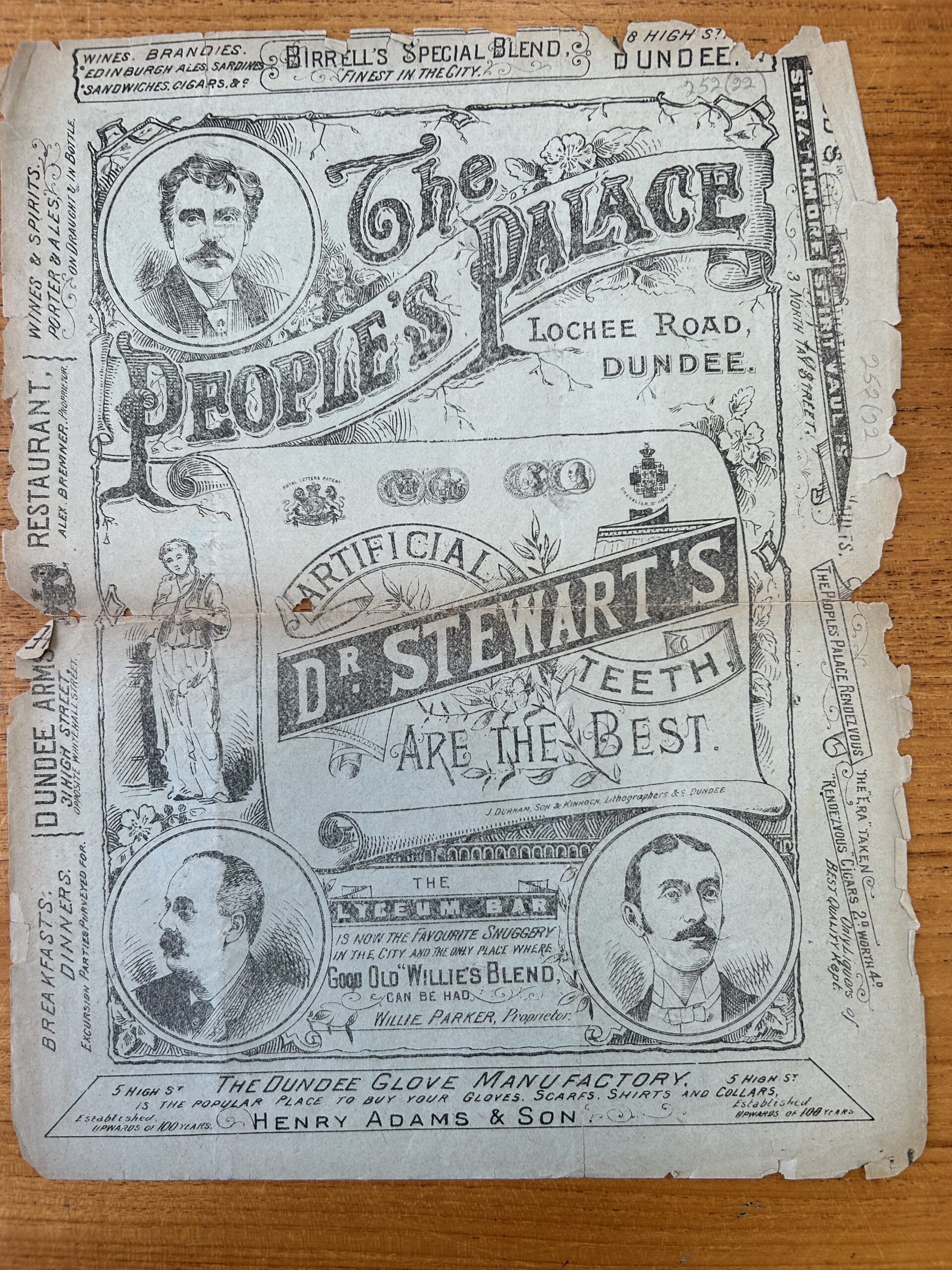
The company was not restricted to provided material for William McFarland either. In 1891 J. Durham, Son & Kinnoch produced several programmes for the Livermore Brothers People’s Palace located in the Old Cattle Market on Lochee Road, all of which highlighted the elegant ambitions for the venue.
For the programme, the company delivered an ornate and chic design. A neat scroll announces the set list, whilst a portrait of proprietor Horace Livermore (top left) engages the viewer. The two portraits at the bottom are likely Ernest Sheldon, Horace’s business partner and brother-in-law, and Clem Fisher, the hall’s Acting Manager. A figure – perhaps Erato, one of the nine Muses representing Lyrical poetry, playing a lyre, or small kithara – poses in contrapposto suggesting the ambitions of the hall, whilst floral decorations contain the picture within a neat border. Any attendee in any doubt as to the moral repute of the Palace, would be reassured by the advisory text at the bottom of the programme: ‘NO WHISTLING ALLOWED’.
The John Kinnoch Years (1905-1911)
On 31 March 1905, James Durham died aged 65 and the business transferred to John Kinnoch, William Mitchell Lamb and John’s son George Duncan Kinnoch, with the firm’s name remaining as John Durham and Son. John Kinnoch was instrumental in developing Durham & Son further as a provider of music hall and theatre printed material:
Under his management the firm were the pioneers in the city of theatrical printing, and during his long connection with the trade Mr Kinnoch made the acquaintance of all the music hall and theatrical stars who visited the city, while he was intimate friend of the late Mr William McFarland, manager of the old Alhambra Theatre, Dock Street, the Music Hall in Castle Street, and latterly of Her Majesty’s Theatre in Seagate.[5]
John Kinnoch died, aged 73, on 21 August 1911.[6] Kinnoch’s death also marked the end of Durham & Son operations at 49 High Street. With the business now passing to Kinnoch’s son George and his partner William Lamb, Durham & Son relocated to premises at in the city’s Overgate.[7]
11-19 Overgate (1911-1962)
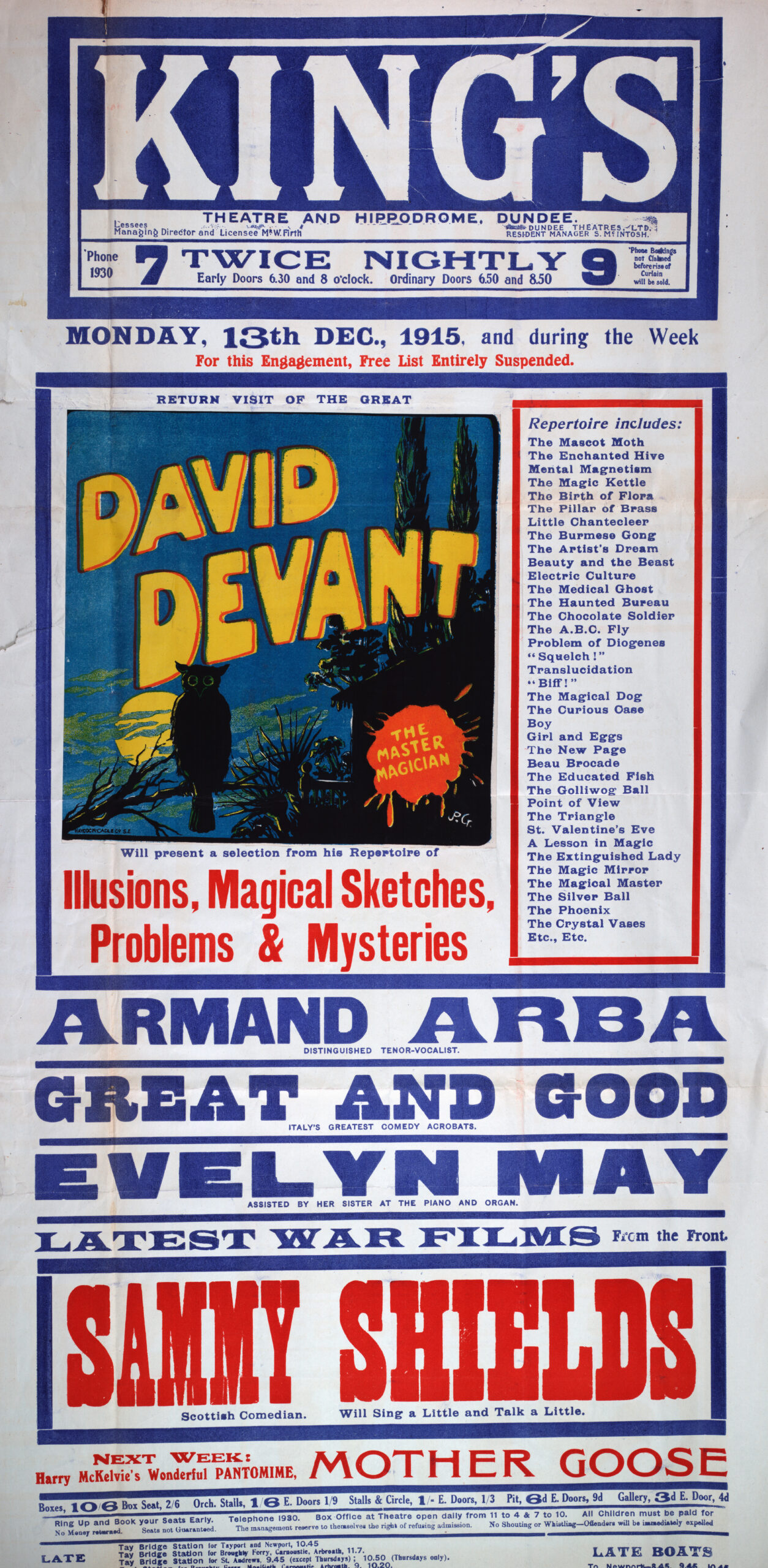
Durham & Son continued to produce posters for a range of Dundee theatres during the early twentieth century, including the King’s Theatre in the Cowgate. Their poster for 13 December 1915, advertising a performance by the celebrated magician David Devant, demonstrates how dramatically poster design had evolved since the firm’s early years. The design employs a vibrant palette of deep blues, vivid reds, and bright yellows to command attention, while the dominant use of blue, red, and white creates a striking visual contrast that may also have evoked patriotic associations during the First World War. Despite its densely packed content, the layout remains clean and well organised, promising audiences an evening of varied and exciting entertainment. Alongside magicians, comedians, acrobats, and vocalists, the programme also advertised the “latest war films from the front,” ensuring that the evening’s attractions were not only entertaining but also reflected contemporary events.
End of an era (1962-72)
In 1962, following plans announced for the redevelopment of the Overgate, Durham & Son relocated for the last time. The firm moved north of the Overgate for its final decade making 5 Constitution Road its home. In 1972, following the retirement of managing directors Percy Sword and William Kidd, John Durham & Son ceased operations after an impressive 136 years.[8]
The closure of Durham & Son marked the end of one of Dundee’s longest surviving printworks. Yet the rich collection of posters, programmes, and playbills held in Dundee’s Local History Centre’s collection preserves a vivid record of the city’s music hall and theatre culture, as well as the lasting contribution Durham & Son made to Dundee’s visual and cultural identity.
Dr Billy Rough, School of Art History, University of St Andrews, 2026
[1] ‘Dundee firm to close after 136 years’, The Courier & Advertiser, 6 November 1971, p.5. See also ‘New Director’, The Courier & Advertiser, 30 March 1972, p.2.
[2] For information on Durham’s address history see the Dundee Directories for 1834 to 1972. Unfortunately, no directories exist for 1835-37 nor 1838-42.
[3] John Durham, Old Parish Registers. Births, 1802. 685/1 Edinburgh. Scotland’s People https://www.scotlandspeople.gov.uk/ (accessed May 2026)
[4] ‘Dundee firm to close after 136 years’, The Courier & Advertiser, 6 November 1971, p.5.
[5] ‘Death of Dundee Printer’, Evening Telegraph and Post, 21 August 1911, p.1.
[6] ‘Death of Well-Known Dundee Printer’, The Courier & Argus, 22 August 1911, p.6.
[7] Scottish Printing Archival Trust, A reputation for excellence: a history of the Dundee and Perth printing industries. Volume 3: Dundee and Perth. Edinburgh: Merchiston Publishing, 1996, p.6. https://www.scottishprintarchive.org/wp-content/uploads/2012/04/Vol-3-Dundee-Perth.pdf (accessed May 2026)
[8] ‘Dundee firm to close after 136 years’, The Courier & Advertiser, 6 November 1971, p.5.