
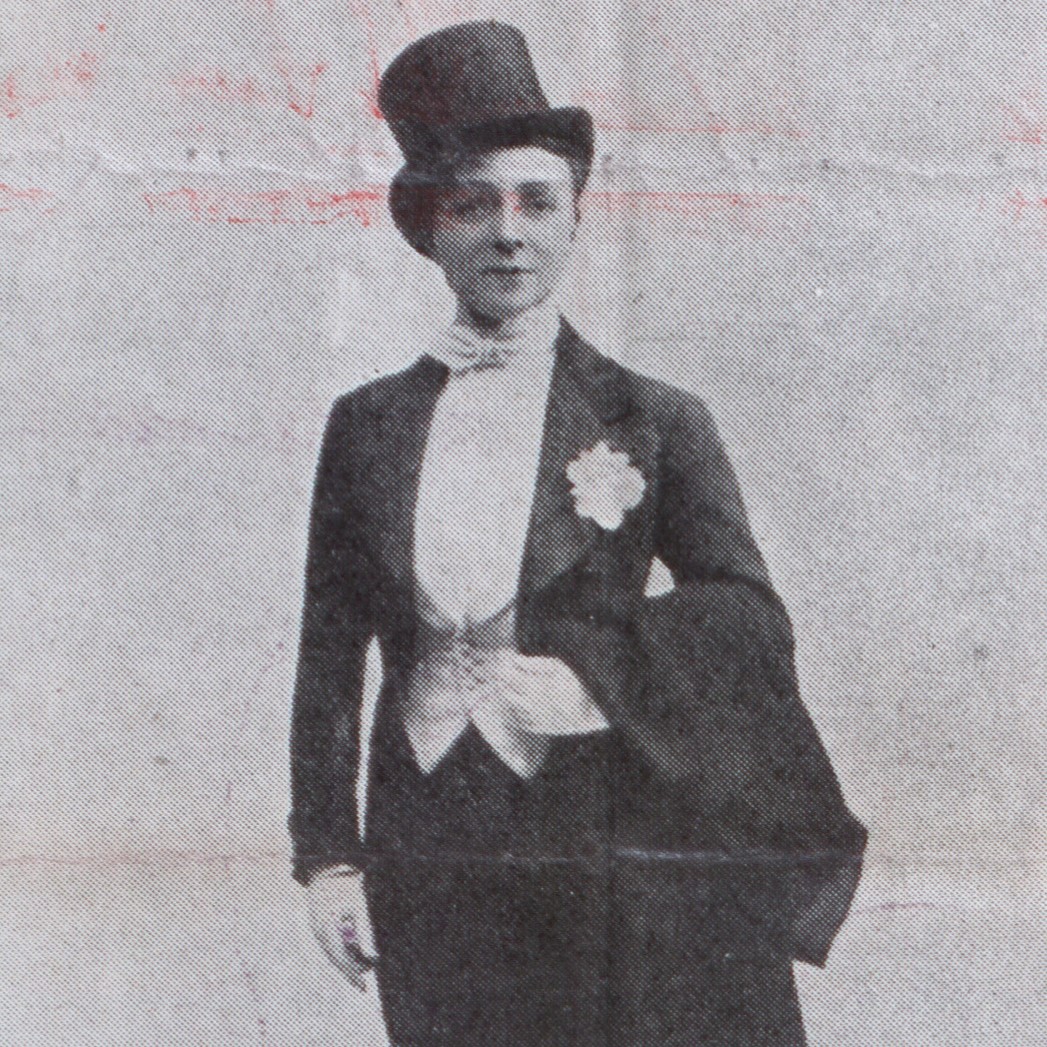
Vesta Tilley is an artiste, but she is more than an artiste. She is a judge of masculine foibles and weaknesses, of the masculine mind and masculine tendencies —in fact, she is man’s interpreter to man himself.
‘The King’s Theatre’, Evening Telegraph & Post, 4 November 1913, p.4.
When modern audiences think of gender performance, they often imagine a distinctly contemporary form of entertainment. Yet gender impersonation was a familiar feature of British popular culture long before the twentieth century. Across Victorian Britain, gender impersonations became a common form of entertainment across Music Halls and Theatres. In particular, Dundee, a city transformed by industry, urbanisation, and social change, music halls offered audiences an opportunity to encounter performers who challenged conventional ideas of masculinity and femininity through song, comedy, and theatrical illusion.
By the late nineteenth century, Dundee’s theatres and music halls regularly welcomed touring stars from across Britain. Among the most fascinating were male and female impersonators, artists who built successful careers by performing a gender different from their own. Figures such as the female impersonator Saphrini and the celebrated male impersonator Vesta Tilley captivated audiences not merely because of novelty, but because their performances revealed how gender itself could be staged, imitated, exaggerated, and transformed. Most notably, Tilley performed at Her Majesty’s Theatre Dundee in 1890 as well as at the King’s Theatre Dundee in the early 1900s. Examining these performers within the context of Dundee’s vibrant entertainment culture offers a window into Victorian attitudes towards gender, celebrity, and popular amusement. Far from being a modern phenomenon, gender performances occupied a visible and often celebrated place on the nineteenth-century music hall stage.
Dundee’s Expanding Entertainment Scene
Throughout the nineteenth century, Dundee experienced dramatic growth. The city’s booming jute industry attracted thousands of workers, creating a densely populated urban centre with a growing demand for leisure and entertainment. As working hours gradually shortened and disposable income increased for some sections of society, theatres, music halls, and variety venues flourished. Music halls became particularly popular because they catered to a broad audience. Unlike traditional theatres, which often focused on dramatic plays and catered to middle-class tastes, music halls offered an eclectic mix of singing, dancing, comedy, acrobatics, and novelty acts. Audiences could enjoy a constantly changing programme featuring both local talent and nationally recognised performers.
The appeal of music hall entertainment lay partly in its ability to play with social expectations. Comic performers frequently mocked authority figures, class distinctions, and everyday frustrations. Gender impersonators fitted naturally into this environment, using humour, costume, and performance to challenge assumptions about how men and women should behave.
The Tradition of Gender Impersonation
Gender performance was not new to Victorian audiences. For centuries, theatrical traditions had incorporated elements of gender disguise. From the traditional, archaic use of male actors as female roles within Shakespearean plays; to pantomime, one of Britain’s most popular theatrical forms, which regularly featured principal boys played by women and comic dames played by men.
Music hall impersonators, however, represented something slightly different. Rather than merely filling a theatrical role, they built entire careers around adopting another gender’s appearance, mannerisms, and social characteristics. Their success depended on convincing audiences through careful attention to costume, gesture, voice, and characterisation.
These performances occupied a fascinating cultural space. Audiences were aware that they were watching an illusion, yet much of the entertainment came from seeing just how convincingly the performer could inhabit another identity. Newspapers often commented on the remarkable realism achieved by successful impersonators, praising their ability to deceive the eye while entertaining the crowd.
Vesta Tilley: The Queen of Male Impersonators
Among the most famous performers to appear on British music hall stages was Vesta Tilley, arguably the greatest male impersonator of the Victorian era. Born Matilda Powles (1864-1952), Tilley developed a stage persona that allowed her to portray a variety of male characters, from military officers and fashionable young gentlemen to mischievous ‘swell’ figures.
Unlike many comic performers, Tilley’s acts relied on careful observation and precise character work. Her portrayals often satirised masculine behaviour, exposing vanity, arrogance, or social pretension while remaining charming and entertaining. With their repertoire of performance usually containing a variation of songs such as their performance of ‘Burlington Bertie’ (c.1900), or their later performance of ‘I’m the Idol of the Girls’ (1908).
In 1891, Tilley was classified as the ‘London Idol’ in The Evening Telegraph, in preparation for her performance at Her Majesty’s Theatre. [1] With many critics complimenting her skill as Randolph the Reckless at Her Majesty’s Theatre, noting her as ‘a burlesque actress of remarkable talent’, and noting her ‘great talents’, ‘lovely face’ and ‘charming figure’. [2] Audiences delighted in her ability to capture the gestures, posture, and speech patterns of men from different social backgrounds.
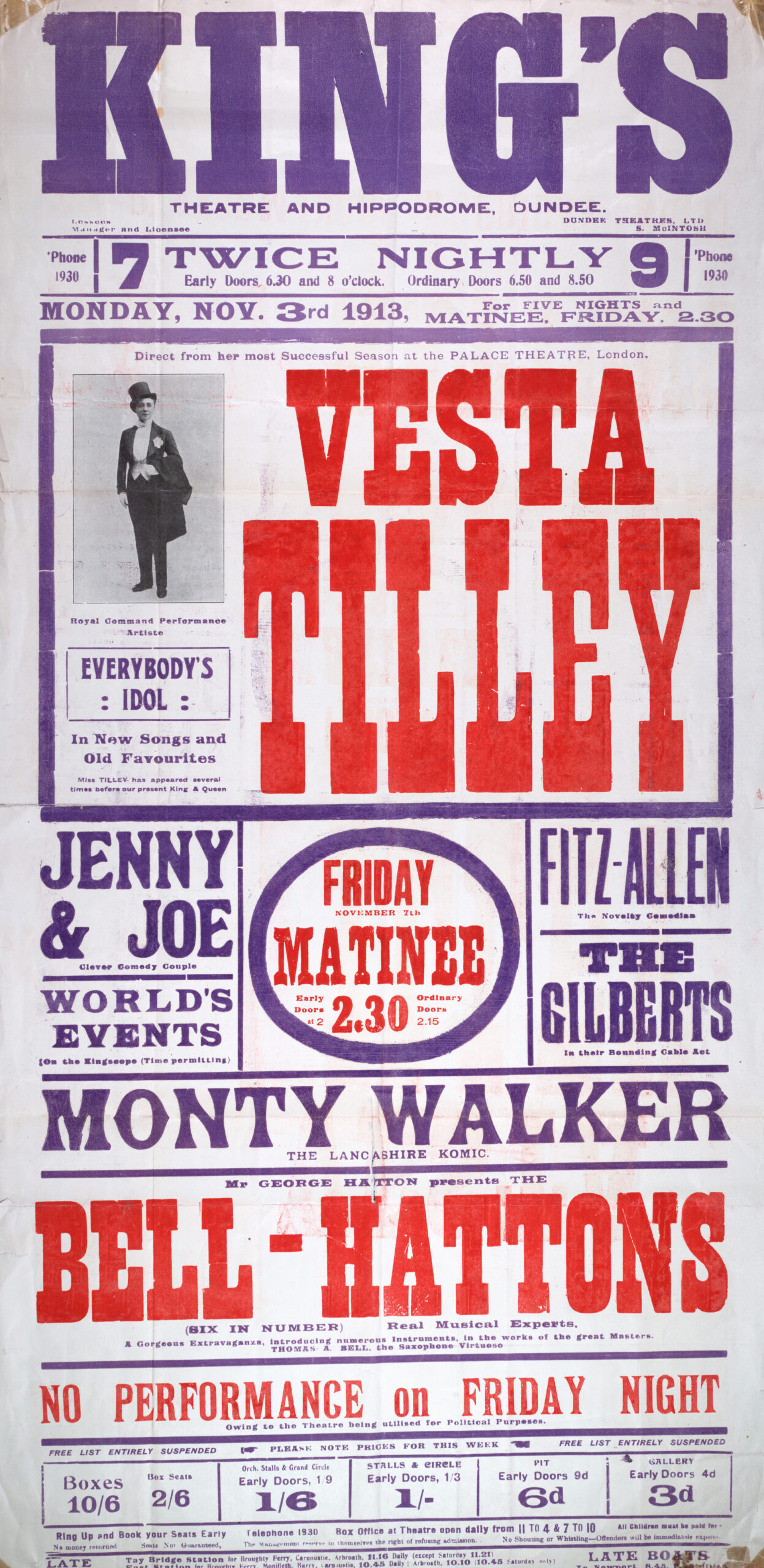
Tilley performed at Her Majesty’s Theatre in Dundee’s Seagate in April and May 1891 and, in 1913, made an appearance at the King’s Theatre – the subject of the poster. Tilley is given a headline performance with a photograph printed alongside, an unconventional and uncommon method of marketing. With the accompanying title ‘everybody’s idol’, here reinforcing their national celebrity status and position within the Music Hall legacy of nineteenth and twentieth century Britain and Scotland.
Tilley’s popularity extended throughout Britain, and her tours brought her to audiences far beyond London. In cities such as Dundee, theatregoers were able to witness one of the most celebrated stars of the music hall world. Her success demonstrates that Victorian audiences were not merely tolerant of gender impersonation but actively embraced it when presented within the framework of popular entertainment.
Interestingly, Tilley’s performances also reflected broader social changes. As debates surrounding women’s rights and gender roles intensified during the late nineteenth century, her adoption of male identities on stage offered audiences a playful exploration of social boundaries. With her her taking on more mainstream roles such as Dick Whittington in 1893 at the Theatre Royal Pantomime in Glasgow, to joining of the New York Women’s Trousers Club in 1904. While she never openly challenged Victorian morality, her performances subtly highlighted the performative nature of gender itself.
Saphrini and the Female Impersonator Tradition
There is but ONE SAPHRINI. This unequalled Impersonator of Female Character….
‘Dundee Music Hall’, The Dundee Courier & Argus, 3 October 1870, p.1.
If male impersonators like Vesta Tilley were widely celebrated, female impersonators also enjoyed considerable success. One notable example was Saphrini, a performer whose appearances attracted attention for their elegance and convincing portrayal of femininity.
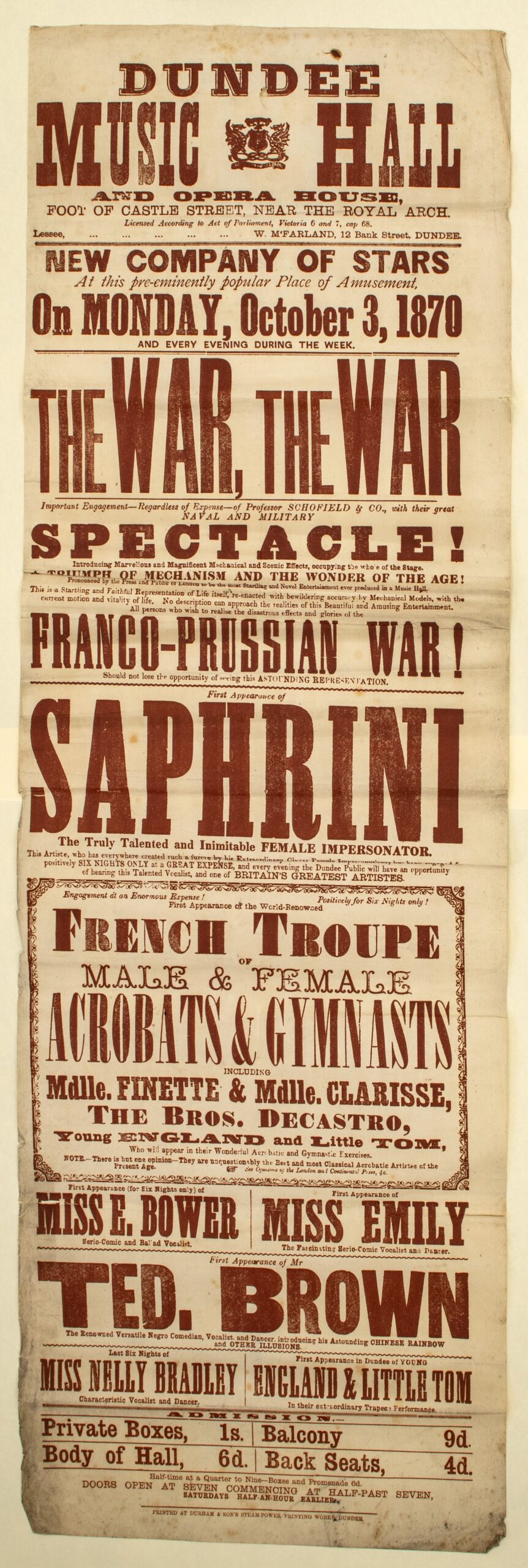
Female impersonators occupied a more complicated position within Victorian culture. Their acts often combined glamour, music, and comedy, with performers presenting idealised versions of fashionable womanhood. Reviews frequently emphasised the beauty of their costumes, the grace of their movements, and the astonishing effectiveness of their transformations.
Unlike Tilley, and beyond his first name (variously noted as Robert and Richard) very little is known about Saphrini. Certainly he was popular in the late 1870s and 1880s and first performed in Dundee in the October of 1870, where he was lauded as the ‘truly talented’ and noted for there ‘extraordinary, clever female impersonations’. [3] Saphrini performed for a six-night showcase, in which the Dundee Music Hall noted him as one ‘Britain’s Greatest Artistes’. [4]
For audiences in Dundee, performers such as Saphrini provided both spectacle and novelty. Yet their appeal went beyond simple curiosity. Successful female impersonators demonstrated a sophisticated understanding of gender conventions, reproducing and exaggerating the gestures, expressions, and behaviours associated with femininity. In doing so, they revealed how much of what society considered ‘natural’ masculine or feminine behaviour was actually learned and performed.
Although Saphrini was primarily known for performing at the Dundee Music Hall and Opera House, making appearances there in March 1868, September and October 1870. Saphrini also performed at The People’s Palace in the Nethergate in September 1896, and his performances reveal an interesting dynamic between gender performance and Victorian theatre. The popularity of female impersonators also illustrates the relatively broad range of entertainment available within Victorian music halls. Audiences who might never encounter discussions of gender identity in everyday life nevertheless paid to watch performers experiment with gender presentation on stage.
Impersonation Legacy
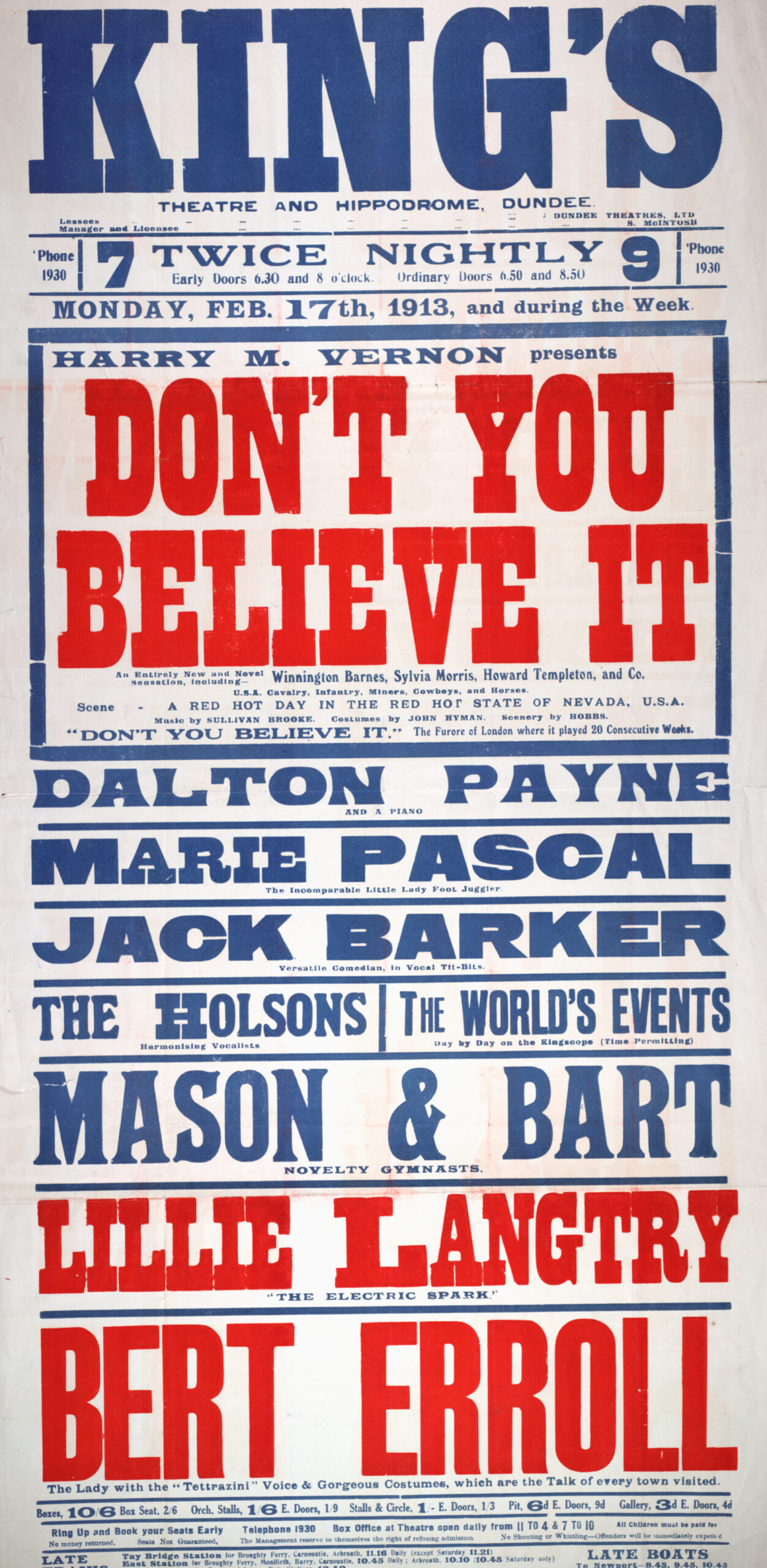
Interestedly, around the same time as Vesta Tilley, another female impersonator was performing at the King’s Theatre. In February 1913, a headline from the King’s Theatre announces the arrival of Bert Errol (1883-1949), a female impersonator who was popular across both Britain and America. Errol, born Isaac Whitehouse, was known for his elaborate stage costumes and outfits, with the King’s Theatre declaring him “The Lady with the ‘Tettrazini’ Voice and Gorgeous Costumes.”
Like Saphrini, Errol’s performances were headline acts and noted for there popularity within Dundee. Errol went on to play in the BBC Radio production of Cinderella in 1935 where his voice and talent were once again lauded and praised.
Celebrity, Spectacle, and Public Fascination
The success of impersonators was closely linked to the emergence of modern celebrity culture. By the late nineteenth century, newspapers regularly advertised performers, reviewed their appearances, and reported on their careers. Photographic portraits circulated widely, allowing audiences to collect images of their favourite stars.
Part of the fascination surrounding impersonators stemmed from the contrast between their stage personas and their private identities. Audiences were often intrigued by the ‘reveal’ that an elegant woman on stage was actually a man, or that a convincing young gentleman was in reality a woman. This interplay between appearance and reality became a central feature of their appeal.
At the same time, Victorian audiences generally viewed these acts through the lens of entertainment rather than social rebellion. Impersonators operated within accepted theatrical conventions and were often regarded as skilled artists rather than controversial figures. Their popularity suggests that nineteenth-century attitudes towards gender expression were sometimes more complex and flexible than modern stereotypes of Victorian society might imply.
Drag in Victorian Dundee
The history of male and female impersonators in Dundee reminds us that drag is not solely a modern cultural phenomenon. Long before contemporary discussions of gender and identity, Victorian audiences flocked to theatres and music halls to watch performers transform themselves through costume, performance, and theatrical skill.
In Dundee’s bustling entertainment venues, artists such as Vesta Tilley and Saphrini offered audiences moments of laughter, amazement, and reflection. Their performances blurred the boundaries between masculinity and femininity, reality and illusion, while demonstrating the extraordinary creativity of the music hall stage. In gaining both a male-to-female (Saphrini), and female-to-male (Tilley), the music halls performances open up larger discussions on gender identity and gender conformity. In seeing both performers receive high praise and success, notions of performing identity and gender can be understood as a form of economic vehicle as well as entertainment.
Today, these performers provide historians with valuable insights into the social and cultural life of nineteenth-century Britain. They reveal a world in which gender could be questioned, imitated, and reinvented before packed audiences’ night after night. Far from existing on the margins of Victorian society, male and female impersonators occupied a prominent place within popular entertainment, proving that the art of drag has a far longer and richer history than many people realise.
Mina Dodd, MLitt Art History Student, School of Art History, University of St Andrews, 2026
[1] ‘Her Majesty’s Theatre’, The Evening Telegraph, 27 April 1891, p.2
[2] ‘Randolph the Reckless at Her Majesty’s Theatre’, The Evening Telegraph, 28 April 1891.
[3] Dundee Music Hall and Opera House, 3 October 1870, p.2.
[4] Dundee Music Hall and Opera House, 3 October 1870.