
…the most successful caterer of amusement for the public that has ever appeared in Dundee…
‘Dundee Music Hall’, The Illustrated Sporting and Theatrical News, 22 August 1868, p13.
His name is perhaps rather forgotten today, but for nearly thirty years William McFarland dominated Dundee’s entertainment environment. From 1866 until his retirement in 1891, McFarland’s management of the Alhambra Music Hall, the Dundee Music Hall and Opera, McFarland’s Theatre of Varieties, and Her Majesty’s Theatre, marked McFarland as the father of Dundee’s entertainment industry; from dioramas and circuses to music halls and legitimate theatre, McFarland’s history mirrors the evolving tastes of 19th-century entertainment, and offers a glimpse into the pleasures Dundee residents could enjoy on a night out.
William McFarland, or ‘Mac’ as his Dundee friends affectionately called him, was born in Southport, Lancashire in 1836.[2] His early career saw him as machinist in Wladishaw’s Mechanical Exhibition of the Russian War before becoming a business agent and ringmaster for ‘Lord’ George Sanger, the circus entrepreneur.[3] In the 1860s, upon encouragement by Sangers, he came to Dundee.[4] In January 1866 Sanger’s Hippodramatic Circus opened in a purpose-built building between Trades Lane, Whale Lane, and Dock Street. Built ‘… for the amusement of the inhabitants, where working men could obtain a few hours’ rational amusement, and perhaps prevent them from going to public houses,’ Sanger’s circus was to become known as the largest building in town, and capable of holding over 2,500 visitors.
McFarland’s presence in the city, likely invited by Sanger himself to help with the opening of the circus, was fortuitous and he would eventually find himself dominating Dundee’s entertainment history for almost thirty years.[5]
In early March 1866, having previously visited the city (Kinnaird Hall) with a panorama of the Holy Land, McFarland exhibited, at the Theatre Royal on Castle Street, a diorama of America, which included scenes of New York and Broadway, as well as a night scene (with an ‘instantaneous change to daylight’) of Isambard Kingdom Brunel’s recently launched SS Great Eastern.[6] The diorama was illustrated by Henry Smith who also provided songs (accompanying himself on the pianoforte), told anecdotes, and provided descriptions of the scenes. It was, according to its own press, ‘the most Magnificent MOVING DIORAMA ever exhibited in Great Britain. Painted by the renowned Mr [David] Roberts, R.A., introducing new and startling Mechanical Dioramic Effects.’[7]
Simultaneously, McFarland took on the lease of Sanger’s East Dock Street circus building, at the considerable sum of £48 per month and, realising the growing demand for music hall entertainment, he set out with a plan to run the building as a music hall in the winter and a circus in the summer.
The Alhambra Music Hall, East Dock Street (1866-1867)
McFarland’s Alhambra opened on the 24th March 1866, yet as a music hall it had a relatively short life, in operation only until November 1867.[8] Certainly, the first week’s entertainment followed that of typical music hall fair with comedian Victor Liston, gymnasts Forster, Roberto and Algiers, soprano Clara Villiers, and a full orchestra under the direction of Signor Giuseppe Operti, a former pianist to Emmanuel II, King of Italy, all taking to the stage.[9] By early April 1866, the hall was being touted as ‘One of the Largest and Most Elegant Music Halls in Great Britain’, with The Era noting that the opening night welcomed an impressive 3,416 persons through the door.[10]
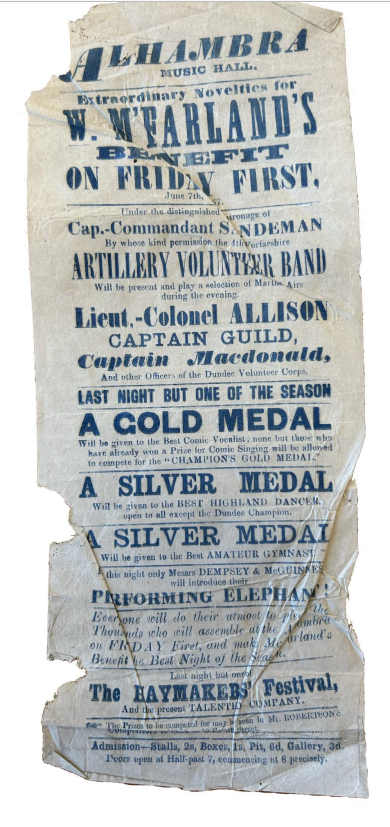
A playbill dating from 1867, provides an insight into the entertainment the Alhambra offered for city residents. ‘Extraordinary Novelties for W. M’Farland’s Benefit’ it proclaims, before highlighting entertainment such as the Forfarshire Artillery Volunteer Band, competitions for ‘Best Comic Vocalist’, ‘Best Highland Dancer’ and ‘Best Amateur Gymnast’. The night would conclude with the Haymakers’ Festival and the appearance of Dempsey and McGuire’s performing elephant.
The Alhambra was a popular venue, attracted several big names to its stage, including George Leybourne, with his trademark song ‘Champagne Charlie’, in March 1867, however within a few short months it was clear McFarland was struggling to attract a large enough audience to justify the building’s considerable costs. Admitting defeat, McFarland applied for bankruptcy in November 1867: ‘The Alhambra did not pay,’ he stated, ‘It has always been a losing concern…‘[11]
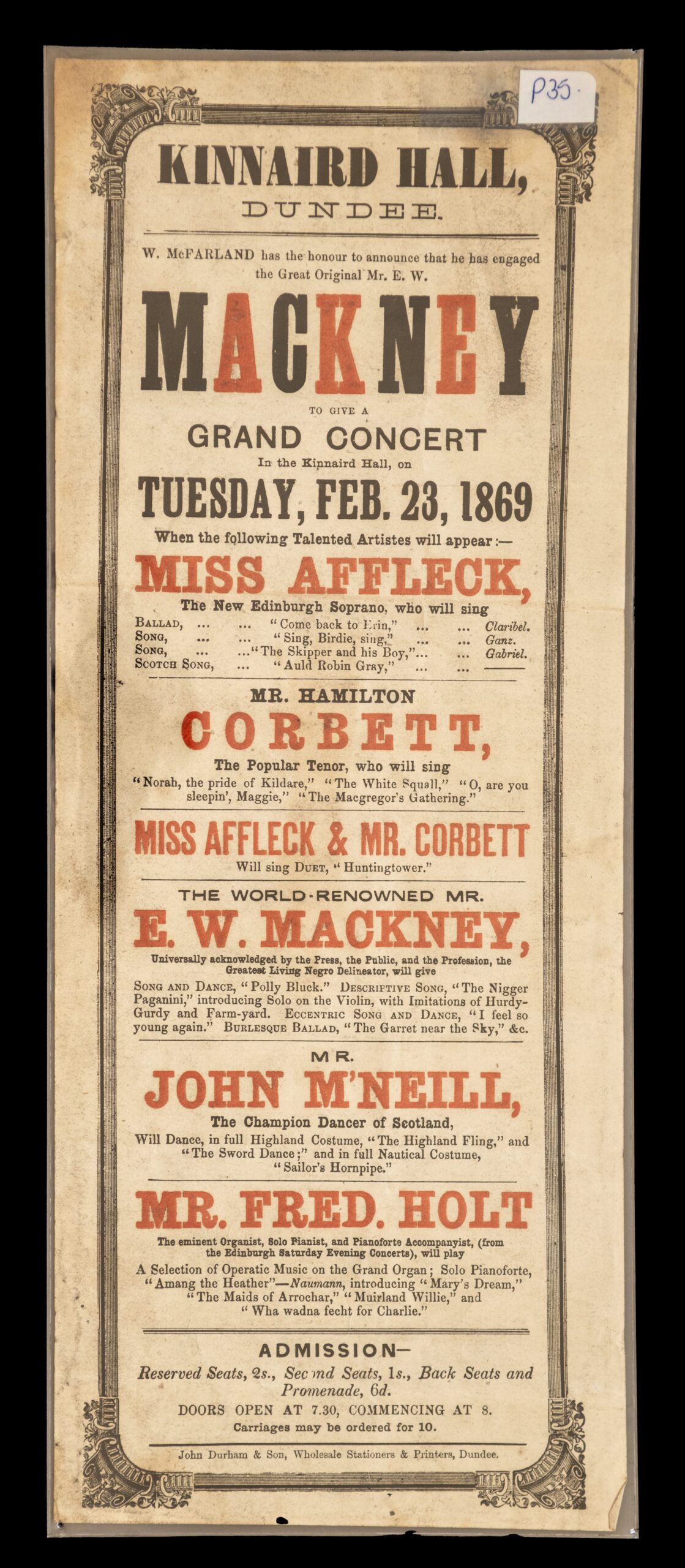
The decline of the Alhambra certainly didn’t stall McFarland’s career. In February 1869 he presented an evening of music hall entertainment at the Kinnaird Hall, including acts such as Miss Affleck, the Edinburgh Soprano, the popular tenor Hamilton Corbett, and blackface performer E.W. Mackney.
The Dundee Music Hall and Opera House, Shore Terrace (1866-88)
In some minds there exists a prejudice against Music Hall performances. That this objection is unfortunately too well grounded we are ready to admit; but it has been the steady aim of Mr McFarland to remove this stigma from the profession.
‘Mr William McFarland. Lessee of the Theatre Royal’, The Wizard of the North, Vol II, No. 15, 25 December 1880, p.2.
The Dundee Music Hall, the ‘finest concert hall in Scotland’, opened in September 1866, originally under the management of the Aberdeen based McLeod Brothers.[12] By 1868, the brothers had decided to focus their attention on their Aberdeen halls and, in August of that year, McFarland took it over renaming it The Dundee Music Hall and Opera House.
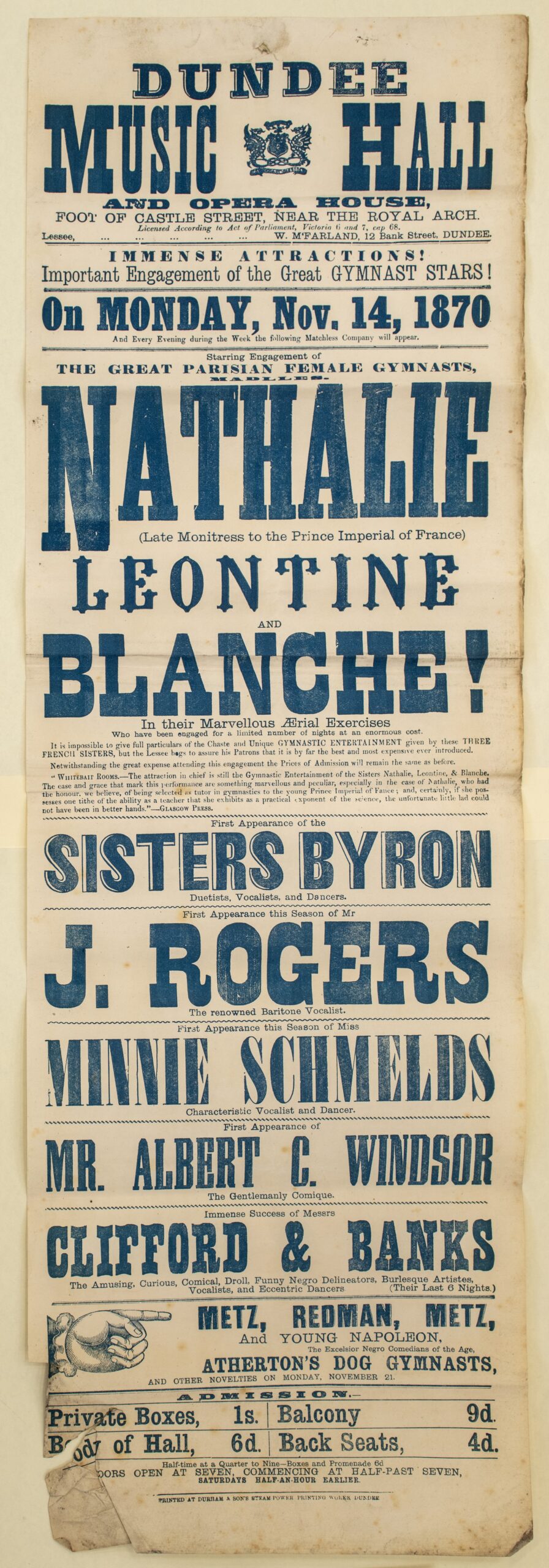
A taste of McFarland’s music hall entertainment can be seen in a poster from 14th November 1870, which promised acts such as ‘The Great Parisian Female Gymnasts’, Nathalie Leontine and Blanche; duettists, singers, and dancers, the Sisters Byron (Duettists, Vocalists and Dancers); the baritone vocalist J. Rogers; vocalist and dancer Minnie Schmelds; the “Gentlemanly Comique” Mr. Albert C. Winsor; and Negro Delineators, Burlesque Artistes, Vocalists, all on one evening! If that were not enough to attract an audience then eccentric dancers Clifford & Banks; Metz, Redman, Metz and Young Napoleon – ‘The Excelsior Negro Comedians of the Age’; and Atherton’s Dog Gymnasts, and other novelties, would be appearing the following week.
By 1888, likely as a result of operating the theatre, alongside that of McFarland’s Theatre of Varieties on Castle Street, and Her Majesty’s Theatre in Seagate, McFarland decided to lease the Dundee Music Hall and Opera House to John Young (later manager of the new Alhambra in Bellfield Street and the Tivoli in Brown Street. Young would rename the hall The Excelsior and would run it until early 1889 when it eventually closed to be redeveloped into the City Assembly Rooms.[13]
McFarland’s Theatre Royal Varieties, Castle Street (1885-1888)
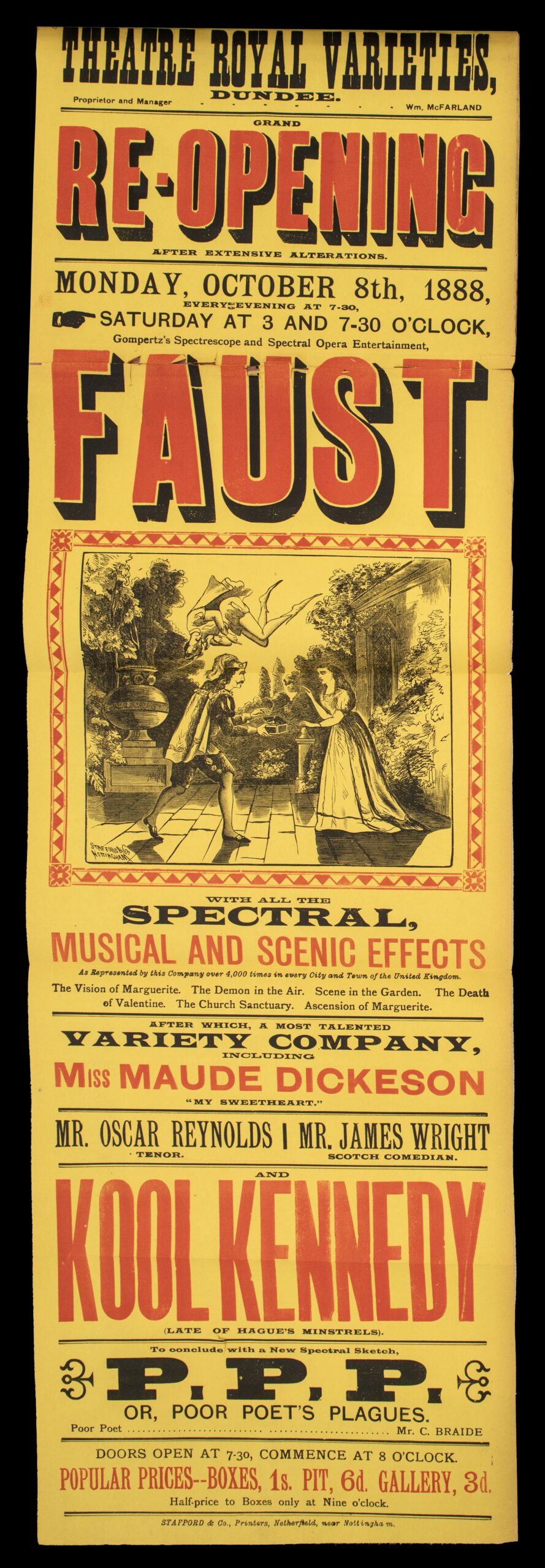
McFarland’s Varieties, on Castle Street, opened in September 1885 in what had previously been known as The Theatre Royal. McFarland was already licensee of the theatre, since September 1876, where he staged dramatic performances, waxwork exhibitions, opera, and music hall performances there. In 1885 he renamed the theatre McFarland’s Theatre Royal Varieties and focused its entertainment on music hall. It closed temporarily, for refurbishment, in March 1888. McFarland’s plans for the future of the theatre can be seen in the poster for Faust: a ‘Spectroscope and Spectral Opera Entertainment.’
Sadly, Faust at McFarland’s was not to be. On the morning of 6th October 1888 the theatre was gutted by fire. The interior was subsequently rebuilt but not as a theatre, and only the façade, complete with Shakespeare’s bust gazing down from the pediment’s roundel gives us a clue as to the building’s previous history.
A sign of McFarland’s dominance in the city theatre history is marked by his appointment as lessee of the recently opened and grand Her Majesty’s Theatre, Seagate (1885-1920). The theatre, built by the burgh architect William Alexander, was owned by the Dundee Theatre & Opera House Co Ltd, which was formed in 1883 to create a new theatre specialising in drama for the city. McFarland would manage the theatre from its opening in 1885 until his retirement in 1891 and it marked a move away from music hall. The theatre was characterised by drama and would welcome many of the pre-eminent theatrical names to its stage, including Ellen Terry, Frank Benson, and Martin Harvey.
McFarland was a well-respected theatre and music hall manager, ‘very popular with all classes, and in the profession no man was more widely known or better liked.’[14]
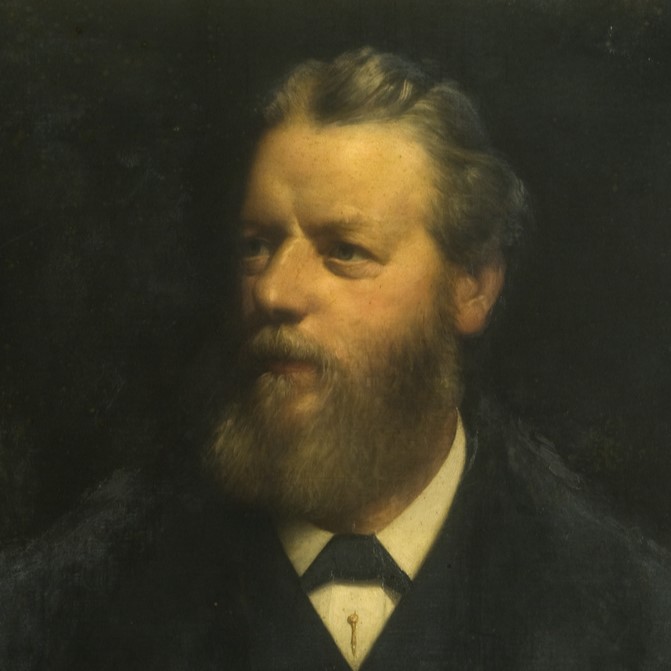
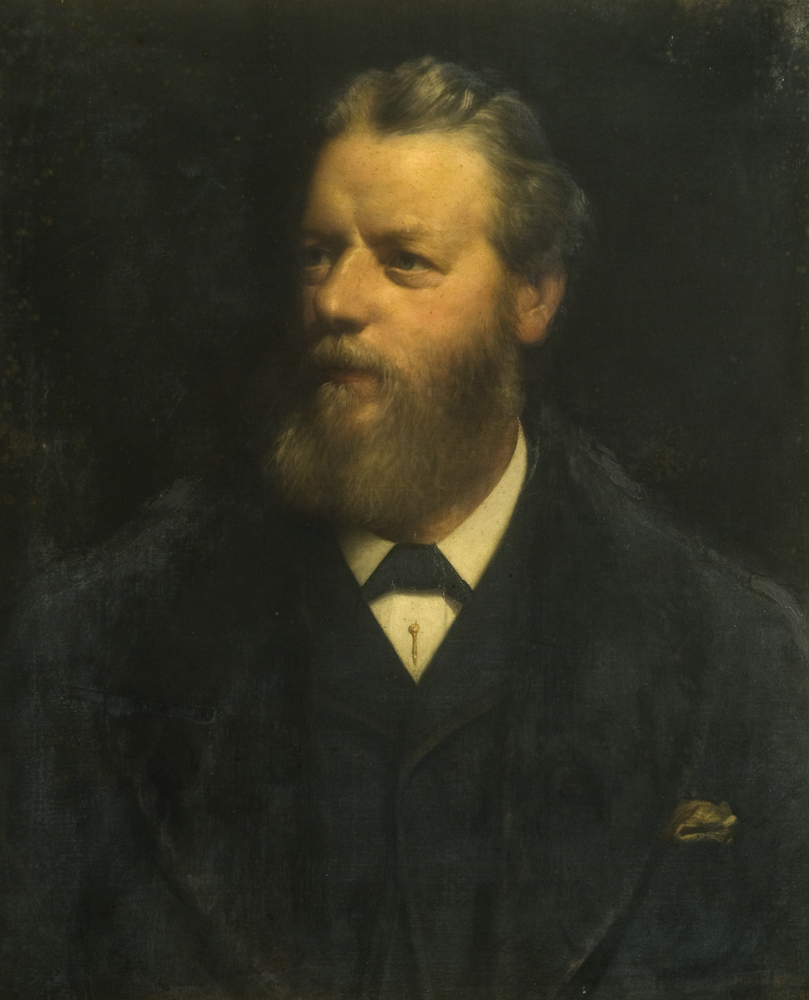
Such was McFarland held in respect that, upon the occasion of his marriage to Elizabeth McKay in 1889, he was presented with Hugh Collin’s portrait in oil, paid for by his employees of Her Majesty’s Theatre. The presentation of the portrait ‘took place on the stage… Mrs McFarland was at the same time made the recipient of a gold brooch set with diamonds.’[16] By 1893 McFarland had returned to Lancashire, taking up ownership of the Becconsall Hotel in Hesketh Bank, about mid-way between Preston and Southport. It was here, at home in his hotel, that he died in April 1898.
McFarland’s story reveals much about Dundee’s entertainment history in the 19th century. It offers valuable insight into how entertainment shaped everyday life in the city, while also shedding light on the demographics of its audiences and the rich variety of performances on offer. Moreover, it provides clues as to how the changing nature of entertainment reflected Dundee’s urban and industrial growth in the late 19th century. McFarland’s steering of Dundee’s entertainment culture, from music hall to more legitimate theatre, helped sustain a vibrant and dynamic cultural scene within the city. It is a legacy still vital today.[18]
Dr Billy Rough, School of Art History, University of St Andrews, 2026
By his enterprise Dundee theatre-goers are made familiar with every piece that has a good metropolitan reputation. The whole family of “Caste” plays, and all Irving’s triumphs, are almost as familiar to the Dundee as to the London public.
‘Mr William McFarland. Lessee of the Theatre Royal’, The Wizard of the North, Vol II, No. 15, 25 December 1880, p.2.
[1] ‘Mr William McFarland. Lessee of the Theatre Royal’, The Wizard of the North, Vol II, No. 15, 25 December 1880, p.2.
[2] ‘Mr William McFarland’s Settlement in England’, The Evening Telegraph, 27 July 1893, p.2.
[3] ‘Mr William McFarland. Lessee of the Theatre Royal’, The Wizard of the North, Vol II, No. 15, 25 December 1880, p.2.
[4] ‘The Late Mr McFarland’, The Dundee Courier & Argus, 15 April 1898, p.4.
[5] In 1882 McFarland took as his permanent residence 2 Tayview Terrace just across the river in Newport-on-Tay.
[6] ‘Diorama of America’, The Dundee Courier & Argus, 5 March 1866, p.2.
[7] ‘Theatre Royal, Dundee’, The Dundee Advertiser, 3 March 1833, p.1.
[8] ‘Opening of the Alhambra Music Hall’, The Dundee Courier & Argus, 26 March 1866, p3. See also, ‘Dundee Bankruptcy Court: William McFarland’, The Dundee Courier & Argus, 29 November 1867, p3.
[9] Alhambra Music Hall’, The Dundee Courier & Argus, 26 March 1866, p1. See also ‘Victor Liston’, The Era, 25 March 1866, p1 and ‘Alhambra Music Hall’, The Dundee Courier & Argus, 26 March 1866, p1.
[10] ‘Dundee Alhambra Music Hall’, The Era, 1 April 1866, p16.
[11] ‘Dundee Bankruptcy Court: William McFarland’, The Dundee Courier & Argus, 29 November 1867, p3.
[12] ‘Dundee Music Hall’, The Dundee Advertiser, 7 September 1866, p1.
[13] ‘The City Assembly Rooms’, The Dundee Courier & Argus, 3 June 1890, p3.
[14] ‘Death of Mr William McFarland’, The Evening Telegraph, 14 April 1898, p.3.
[15] ‘Mr William McFarland. Lessee of the Theatre Royal’, The Wizard of the North, Vol II, No. 15, 25 December 1880, p.2.
[16] ‘Death of Mr William McFarland’, The Evening Telegraph, 14 April 1898, p.3.
[17] ‘Dundee Music Hall’, The Illustrated Sporting and Theatrical News, 22 August 1868, p13.
[18] Section adapted from: Billy Rough, ‘“Fun Without Vulgarity”: A brief history of Dundee’s music halls, from the 1840s to the Great War’, A Dundee Miscellany. Abertay History Society, 2023, pp.105-140.