
Content Warning: Readers should be aware that this essay examines nineteenth-century texts and performances that include racist, discriminatory, and derogatory language. Such language is reproduced or discussed only where necessary to understand the historical sources and the social contexts in which they were produced. The essay critically analyses these materials and does not endorse the views or prejudices they express.
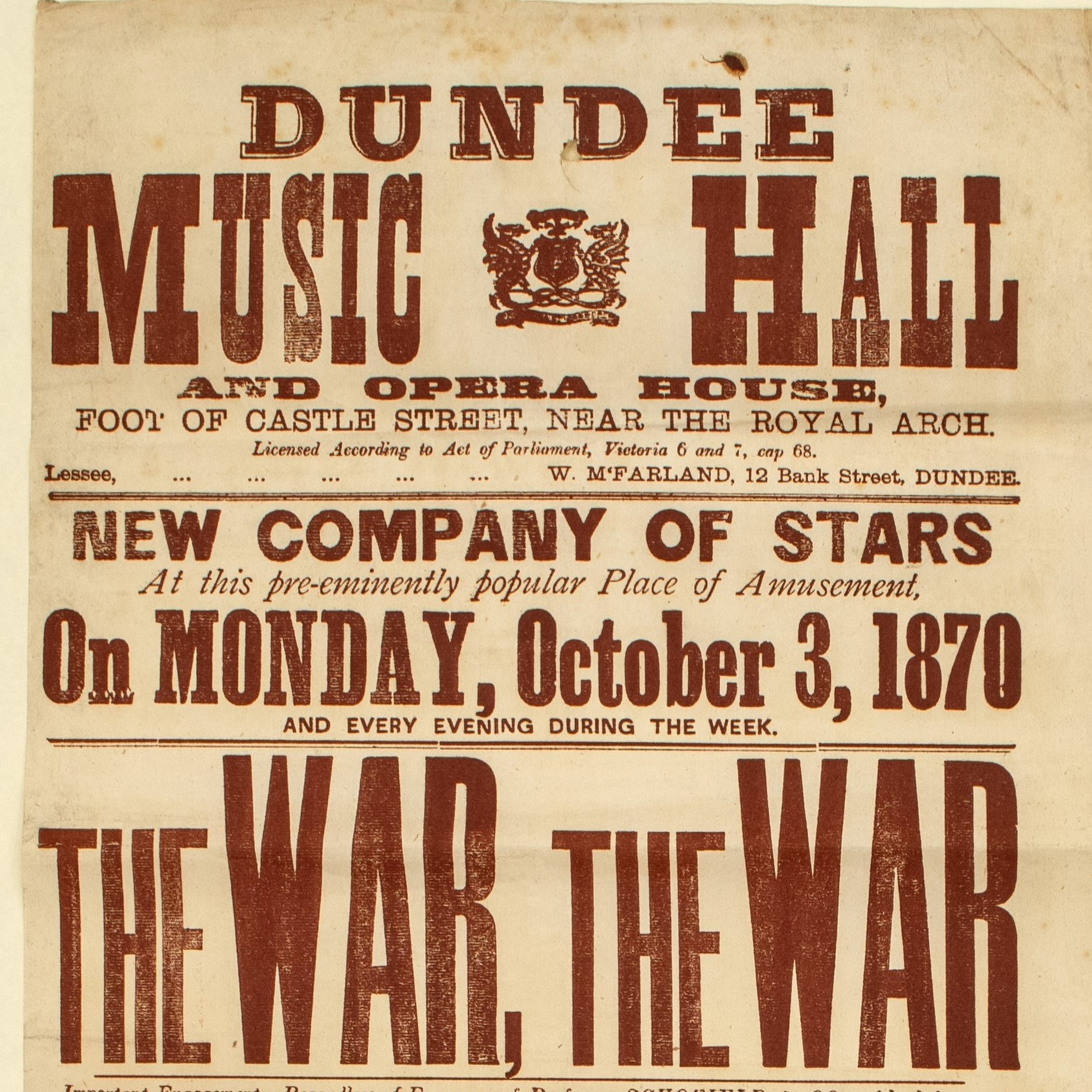
Even a single surviving music hall poster can reveal a great deal. The poster for the Dundee Music Hall and Opera House, dated 3 October 1870, offers valuable insights into the kinds of entertainments popular at the time, the broader social purposes of the music hall, and the evolving aesthetics of nineteenth-century poster design. What follows is a brief analysis of this poster, exploring what it reveals about popular entertainment, audience culture, and the design of marketing material relating to music hall in the late nineteenth century.
Reputation and Licensing
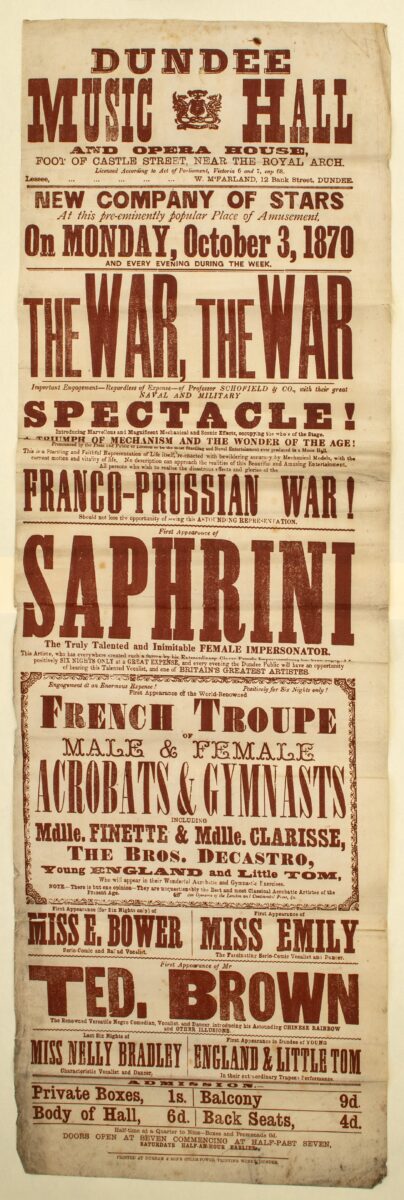
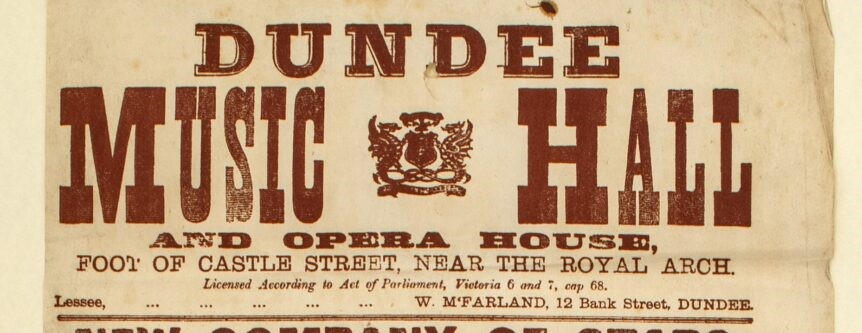
Between 1868 and 1888, the Dundee Music Hall and Opera House was managed by the ubiquitous William McFarland, who developed the hall into one of Dundee’s most successful and long-lasting music hall venues. McFarland was eager to establish himself within Dundee’s entertainment industry and was particularly determined to distinguish his venue as a refined and respectable form of popular entertainment. A clue to the ambitions of the hall can be found in its name, especially its identification as an ‘Opera House’, although little opera actually took place in the venue. The hall was a significant step up from McFarland’s previous venture – the Alhambra Music Hall on East Dock Street, which began life as a wooden circus building and closed in 1867. The Dundee Music Hall and Opera House was housed in a grander venue, the classically-detailed Exchange Buildings, located at the foot of Castle Street and on the corner between Exchange Street and Shore Terrace. Built in 1828, Exchange Buildings operated first as a coffee house, library and reading room. Above the ground floor shops was a large hall which was used initially as an assembly room before its conversion into a music hall in 1866.
The statement near the top of the poster – ‘Licensed according to Act of Parliament, Victoria 6 and 7, cap 68’ – refers to the Theatre Act of 1843. ‘Victoria 6 and 7’ refers to the third session of the 14th Parliament of the United Kingdom, which met from 2 February 1843 until 24 August 1843, whilst ‘cap 68’ relates to the ‘Act for regulating Theatres’.
The Theatres Act 1843, also known as the Theatre Regulation Act 1843, amended the restrictive Licensing Act 1737 and reduced some of the powers previously exercised by the Lord Chamberlain’s Office, a department within the Royal Household of the United Kingdom. The Office had regulated British theatre since 1737 and effectively operated as a system of government censorship over dramatic performances. Although scripts still required licensing from the Lord Chamberlain’s Office before performance, the 1843 Act limited the grounds upon which censorship could be exercised. Under the Act, the Lord Chamberlain could prohibit a play only if he judged it necessary ‘for the Preservation of good Manners, Decorum, or of the public Peace so to do’, either permanently or ‘for such Time as he shall think fit’. [1]
The Act was aimed primarily at theatres performing spoken drama rather than music halls, regulating staged plays and other dramatic performances. However, the inclusion of this statement on the Dundee Music Hall and Opera House poster suggests McFarland’s intention to stage at least some dramatic productions, while also emphasising the hall’s respectability and compliance with the law. This was particularly important at a time when music halls were frequently criticised as morally suspect spaces associated with vice, disorder, and unruly behaviour. As the hall’s advertising aimed to make clear, the Dundee Music Hall and Opera House was ‘THE PLACE TO SPEND A HAPPY EVENING! AMUSEMENT VOID OF VULGARITY!’[2]
A night at the Music Hall
On the evening of Monday 3 October 1870, the Dundee Music Hall and Opera House offered a typical fare of music hall entertainment. Saphrini, the female impersonator, was making the first of his many appearances at the hall, whilst a French troupe of acrobats and gymnasts would ‘appear in their Wonderful Acrobatic and Gymnastic Exercises’, which included a ‘TERRIFIC LEAP for LIFE through a FIRE BALLOON.’[3]
Serio-comics Miss E. Bower and Miss Emily would also make their first appearances at the hall, as would Ted Brown, the ‘Renowned Versatile Negro Comedian’. Nelly Bradley, the ‘characteristic vocalist and dancer’ would come to the end of her six nights at the hall, while England & Little Tom’s trapeze performance would stage their first appearance in Dundee. The emphasis on first appearances demonstrates the importance of novelty to the music hall business model. Each week offered new entertainments encouraging visitors to return to the hall again and again.
Entertainment: The Franco-Prussian War
A valuable way of encouraging repeat visits to a music hall was through topicality, and in October 1870 the Dundee Music Hall and Opera House staged a performance based on one of the most widely discussed events of the day: a re-enactment of scenes from the Franco–Prussian War. Fought between the Second French Empire and the North German Confederation led by the Kingdom of Prussia, the conflict lasted from 19 July 1870 to 28 January 1871, placing the Dundee performance almost exactly midway through the war.
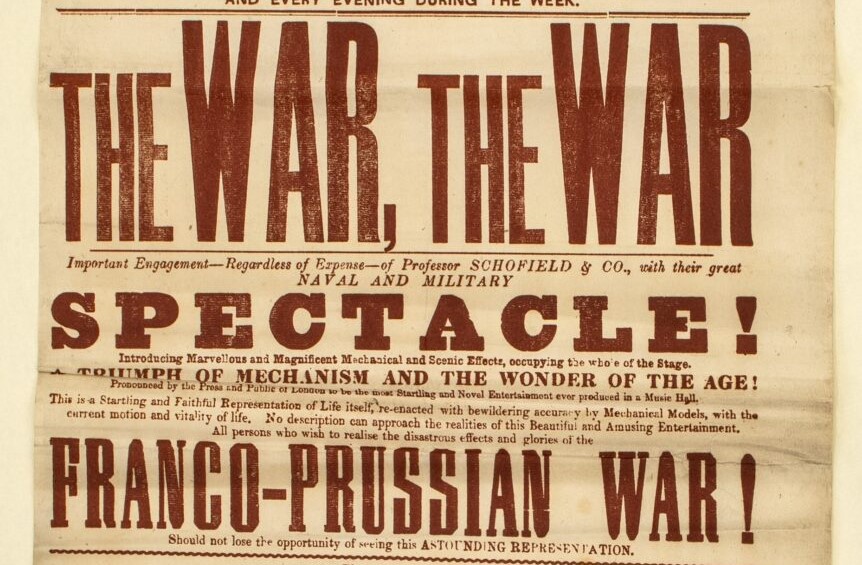
Schofield’s production promised audiences ‘Marvellous and Magnificent Mechanical and Scenic Effects’ and ‘the most Startling and Novel Entertainment ever produced in a Music Hall’.[4] Whilst there is little clue as to the nature of the production, publicity made sure it was a performance not to be missed: ‘The War! The War!! The War!!! Schofield & Co’s Original Grand Naval and Military Spectacle of the WAR, with Novel Mechanical Effects.’[5] The production consisted of a re-enactment of ‘bewildering accuracy by Mechanical Models, with the current motion and vitality of life. No description can approach the realities of this Beautiful and Amusing Entertainment.’[6]
Today, Professor Schofield and Company’s productions are largely forgotten, yet they formed part of a wider vogue for mechanical battle re-enactments that enjoyed considerable popularity in British music halls during the 1870s. Earlier productions had included scenes from the siege of Sebastopol, and the company toured extensively throughout the United Kingdom during the decade.[7]
Schofield’s production closed the evening ‘with a grand mechanical spectacle of the Franco-Prussian war. The last scene presented is one of imposing beauty, illuminating the whole house, and the imitation of shells and cannonading were magnificent.’[8] Their prominence on the Dundee bill demonstrates both the commercial appeal of such spectacles and audiences’ appetite for performances connected to current affairs. These productions offered not only entertainment but also a form of popular education, allowing audiences to engage theatrically with international news and warfare unfolding in real time: ‘GREAT EXCITEMENT! THUNDERS OF APPLAUSE.’[9] A revealing indication of audience sympathies may also lie in the inclusion on the same programme of a French troupe of acrobats and gymnasts: ‘one of the cleverest that has yet appeared in Dundee.’[10] At a moment when the conflict dominated newspaper coverage across Europe, their appearance hints at the complex interplay between spectacle, politics, and popular entertainment within the Victorian music hall.
Entertainment and the Music Hall: Female Impersonators
A popular form of entertainment in the music hall was that of gender impersonation, in which artists adopted the dress, mannerisms, and stage personas of the opposite sex. Vesta Tilley (1864–1952), for example, achieved considerable fame as a male impersonator, most often performing as a fashionable young dandy, with her best-known character being Burlington Bertie.
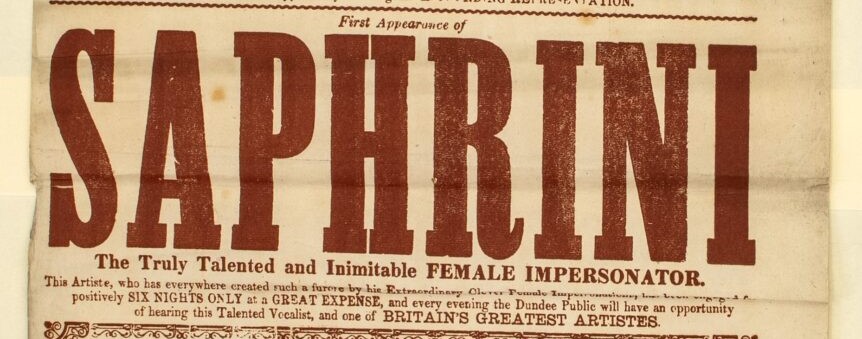
Less well-known today is Saphrini, a male-to-female impersonator, who toured the halls of Britain in the mid to late nineteenth century and was clearly a popular attraction for Dundee audiences. The poster advertised Saphrini as ‘The Truly Talented and Inimitable FEMALE IMPERSONATOR’, proclaiming:
This Artiste, who has everywhere created such a furore by her Extraordinary Clever Female Impersonations has been engaged for positively SIX NIGHTS ONLY at a GREAT EXPENSE, and every evening the Dundee Public will have an opportunity of hearing this Talented Vocalist, and one of BRITAIN’S GREATEST ARTISTES.
Dundee Music Hall and Opera House poster, 03 October 1870. Local History Centre Poster Collection, Dundee Central Library.
Little is known about Saphrini’s personal life, and even his first name remains uncertain, having been identified variously as Richard and as Robert.[11] Despite this obscurity, contemporary reports make clear that he was a successful and highly entertaining performer, frequently being ‘greeted with a perfect furore of cheering and applause.’[12] While the content of his repertoire is largely unknown and his songs have not been identified, reviews consistently praised the quality of his presentation and stagecraft: ‘Saphrini, the female impersonator, is really a grand treat himself. His get-up is firstclass, and his dancing capital.’[13]
The popularity of both male and female impersonators demonstrates the flexibility of gender performance within the music hall. Although Victorian society is often characterised as socially conservative, the music hall provided a space in which audiences could enjoy playful challenges to conventional ideas of masculinity and femininity. These acts did not necessarily undermine prevailing gender norms, but they did reveal an appetite for performances that blurred and explored gender boundaries. The success of performers such as Saphrini suggests that impersonation was not merely a novelty but an established and celebrated feature of popular entertainment, offering audiences an opportunity to engage with gender in ways that were humorous, theatrical, and occasionally subversive.
Entertainment: Women on the Music Hall Stage
Among the performers listed on the bill are two women; Miss E. Bower (‘Serio-Comic and Ballad Vocalist’) and Miss Emily (‘The Fascinating Serio-Comic Vocalist and Dancer’). The term ‘serio-comic’ is less familiar today, but in the Victorian music hall such a performance was characteristic of music hall culture. A serio-comic typically involved a performer singing songs with comic material but laced with a serious, or sentimental, edge. Female serio-comics were enormously popular, with women appearing on the music hall stage in numbers broadly comparable to their male counterparts. For example, of the 1,883 London performers listed in the 1878 edition of The Era Almanack, 384 were described as ‘women serio-comics’ and 357 as ‘male comic singers’.[14]

The music hall offered women an important opportunity by giving them a visible public stage on which to perform and communicate. Within this setting, they were able to explore subjects drawn directly from everyday experience. Serio-comic performers, using song, expressed hopes and disappointments, anxieties and joys, building a sense of connection with audiences who often recognised these same realities in their own lives. While humour was frequently used as a framing device, the underlying themes of the songs carried genuine and relatable meaning. Of the performers in Dundee, three were members of the ‘serio-comic sisterhood’, a sign of just how popular such acts were.[15]
Little is known of Miss E. Bower. As is often the case with music hall performers who used stage names, her identity has been lost to time, but it seems she favoured the emotional content of her songs; in an advertisement from 1874 she was identified as a ‘Sentimental and Comic Vocalist.’[16] An insight into her performance is provided in a review of her Dundee visit, which noted: ‘Amongst the lady performers are Miss E. Bower, who is a serio-comic and ballad vocalist of rare ability, and her rendering of “The Lover’s Request” was received with rapturous applause.’[17]Even less is known about Miss Emily, but the Dundee Courier & Argus provides a small clue to her performance: ‘Miss Emily, as a serio-comic vocalist and dancer, never fails to please the audience. Her dancing of “Jack o’ Tar” and several other dances were very much admired.’[18] The bill also included Miss Nelly Bradley, a ‘Characteristic Vocalist and Dancer’ who was known as an ‘accomplished and vivacious serio-comic.’[19]
Youth was present on the stage too. Included as part of the acrobats and gymnast bill were the ‘miniature gymnasts’ Young England and Little Tom.[20] Known for their daring performances on the trapeze: ‘were it not for the network underneath in case of accident, causing your very blood to “creep”’, the pair would attack the net in a variety of somersaults and often conclude their act with a fly through a paper hoop.[21] As one reviewer noted, at the time of their Dundee appearance, neither of them were over the age of twelve years old.[22]
Entertainment and the Music Hall: Race and Representation
Towards the bottom of the poster, in bold type, appears the name ‘Ted Brown’. A clue to the nature of his act is provided by the poster’s description of him as ‘The Renowned Versatile Negro Comedian, Vocalist, and Dancer’. As with Saphrini, relatively little is known about Brown. He first gained prominence as one half of a duo: Joe and Ted Brown, the ‘Montreal Minstrels, Negro Comedians, Vocalists, and Boot and Clog Dancers’, and his act formed part of the tradition of blackface minstrelsy, a style of entertainment that was immensely popular in nineteenth-century Britain.[23]
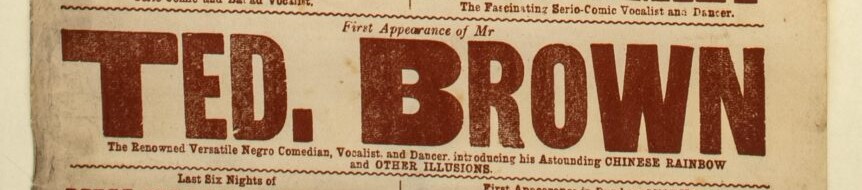
Originating in the United States and becoming established in Britain from the 1840s onwards, blackface minstrelsy involved performers darkening their faces with burnt cork and presenting comic songs, dances, and sketches based on highly stereotyped representations of Black people. Troupes such as the Christy Minstrels achieved enormous success and helped make minstrelsy a staple feature of music hall and variety entertainment throughout the Victorian period. Audiences were drawn to the lively music, dancing, humour, and spectacle of these performances, and blackface acts frequently appeared alongside singers, comedians, acrobats, and other variety artists.
Today, however, blackface minstrelsy is recognised as a deeply problematic form of entertainment that both reflected and reinforced contemporary racial prejudices and imperial attitudes. While performers such as Brown received praise from contemporary reviewers (‘Ted Brown, the negro comedian, is a firstclass [sic] hand…’[24]) such acclaim must be understood within the social and cultural context of Victorian Britain. Although minstrelsy was a significant and popular element of nineteenth-century music hall culture, it relied upon racial caricature and exclusion, and its legacy serves as an important reminder of how popular entertainment could both shape and reproduce ideas about race and identity.
Admission Prices
Entry prices can also reveal much about the audiences that attended the venue. Admission to the Dundee Music Hall and Opera House ranged from 1 shilling for a private box to 4d (four old pence) for seats at the back of the hall, the cheapest available option.
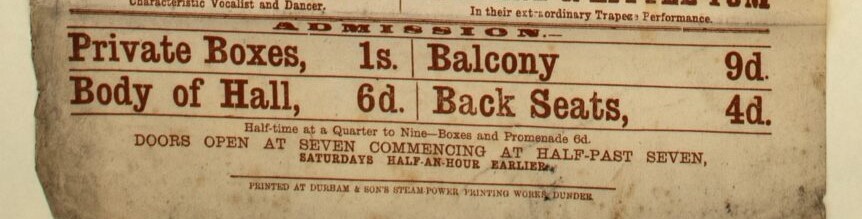
Although precise information on wages in Dundee’s mills during the 1870s is difficult to obtain, James Thomson, writing in the early 1870s, provides useful comparative figures for 1873. Thomson records that a shifter working a 60-hour week in the mills earned an average wage of 7 shillings per week, while weavers could expect to earn between 13 and 16 shillings. It is worth noting that, although men worked in the mills, women constituted a significant proportion of the workforce, often because they could be employed at lower wages and were well suited to moving between spinning and weaving machinery. Boys typically earned between 6 and 8 shillings per week, whereas Weaving Overseers could earn between 28 and 40 shillings weekly.[25]
Further evidence from Dens Works on Princes Street, dated March 1873, indicates that a Weaving Overseer received a monthly salary of between £7 and £7 10s. [26] Admission prices at the Dundee Music Hall and Opera House were therefore relatively affordable, particularly for the cheaper seats. Even workers on modest wages could potentially attend several performances each week if they so desired, suggesting that such venues were accessible to a broad section of Dundee’s working population.
Fonts and Typefaces
The Durham & Son poster also provides fascinating insights into nineteenth-century fonts and typefaces. It makes effective use of a wide variety of lettering styles, clearly intended to attract attention and create visual impact. Identifying specific typefaces, however, can be challenging. In type specimen catalogues of the period, relatively few were given distinctive names; instead, they were often identified by size, style, and a catalogue number, such as ‘Two-line Pica Decorative No. 17’. Furthermore, identical typefaces frequently appeared under different names in the catalogues of different foundries. Some designs were evidently very popular and were widely copied, whether through piracy or licensing arrangements. Many styles originated in the United States before being adopted by printers in Britain and continental Europe, often with official sanction. Complicating matters further, the names of several type styles were not fixed, and alternative terms were commonly used. For example, ‘Dundee Music Hall’ employs two distinct typefaces. ‘Dundee’ is set in Bold Clarendon – sometimes identified as an Antique-style typeface characterised by square serifs – with a line-shadow effect. ‘Music Hall’, by contrast, found in Frederick Ullmer’s Catalogue of Type, uses a generic Italian Antique style typeface (also known as French Antique), distinguished by its unusually heavy horizontal strokes and lighter verticals.[28]
Several other headings make use of common wood-letter type styles. ‘Franco-Prussian War’ is set in a generic Grecian-style Condensed Antique, identifiable by its diagonally cut corners. ‘Saphrini’ is also rendered in a generic Condensed Antique face. ‘French Troupe’, by contrast, appears in a generic Fatface style, one of the earliest decorative display types introduced in the early nineteenth century. ‘Ted Brown’ combines two sans-serif typefaces – known during the nineteenth century as Grotesques. It is possible that the ‘w’ and ‘n’ are from different fonts, although they may simply reflect the inconsistencies in weight and proportion often found in lower-quality types. Beneath ‘French Troupe’, the type used for ‘Male & Female’ can be found in Ullmer’s Catalogue of Type and identified as Bourgeois Classic (new) (No.332).[29] ‘Acrobat & Gymnasts’ can be found in Ullmer’s too (‘Extra Elongated’).
Design and the Poster: Durham & Son
As noted, the primary purpose of a poster is to capture attention through its visual appeal and design. To achieve this, William McFarland enlisted his regular printer for the production of the poster, Durham & Son, whose steam-powered printing works were located at 49 High Street, Dundee. It should be noted, however, that McFarland had several halls across the country, including in Aberdeen, and the bill of entertainment would often tour as one. Several of his entertainment posters follow a similar design too, so it is feasible that his posters were designed and printed in one location, with space left at the top for the relevant city printer to include title of the hall, location, and dates; and a space at the bottom for the printer to include details of their own premises.
The 1870 poster was produced at a pivotal point in the development of printing design, echoing the text-heavy letterpress process characterised by early nineteenth-century printing, yet produced just before the wider impact of colour lithography, developed by Jules Chéret. Letterpress printing uses raised metal letters that are inked and pressed onto paper to print text or images. Colour lithography allows printing in colour by using several stones or plates, each with a different colour, printed one after another to build up the final image. Only one ink colour was used here, a dark red-brown. Durham would later use multiple colours on later Dundee Music Hall and Opera House posters, but for this early example affordability appears to have been a key consideration. Using a single colour required only one print run, reducing both production time and cost.
The design is relatively minimal yet effective. Although the poster relies on dense typography, Durham introduces visual variety through the use of multiple typefaces and font sizes. Each act is distinguished by bold lettering, while smaller descriptive text encourages closer engagement from the viewer. The urgent, attention-grabbing language reflects the rapidly expanding urban entertainment economy of Victorian Britain, while the mix of condensed sans-serifs, slab serifs, ornamental display fonts, and decorative scripts exemplifies the eclectic style of Victorian commercial design.
A ‘pre-eminently popular Place of Amusement’
Overall, Durham’s October 1870 Dundee Music Hall and Opera House poster serves as a valuable case study of Victorian music hall culture in microcosm. Through a single printed sheet, it reveals the diverse forms of entertainment that attracted audiences, from acrobats and serio-comics to gender impersonators, mechanical war spectacles, and minstrel performers. It also provides insight into the social function of the music hall as an accessible and affordable leisure space for a broad section of Dundee’s population.
Beyond its entertainment value, the poster offers evidence of wider cultural attitudes relating to gender, race, respectability, and popular engagement with current events. At the same time, its typography and design illustrate the visual strategies used by printers and managers to compete for attention in an increasingly crowded urban leisure market. As both a promotional device and a historical artefact, the poster reveals how popular entertainment was advertised, experienced, and understood in late nineteenth-century Britain. More than simply announcing a programme of performances, it captures a vibrant world of spectacle, novelty, and commercial showmanship that lay at the heart of Victorian music hall culture. Crucially it promises an exciting and varied night out!
Dr Billy Rough, School of Art History, University of St Andrews, 2026
[1] 1843: 6 & 7 Victoria c.68: Theatre Regulation Act, XIV. The Statutes Project: Putting Historic British Law Online: https://statutes.org.uk/site/the-statutes/nineteenth-century/1843-6-7-victoria-c-68-theatre-regulation-act/ (accessed May 2026)
[2] ‘Dundee Music Hall’, The Dundee Courier & Argus, 7 October 1870, p.1.
[3] Dundee Music Hall & Opera House, 3 October 1870. See also ‘Dundee Music Hall’, The Dundee Courier & Argus, 7 October 1870, p.1.
[4] Dundee Music Hall & Opera House, 3 October 1870.
[5] ‘Dundee Music Hall’, The Dundee Courier & Argus, 6 October 1870, p.1.
[6] Dundee Music Hall & Opera House, 3 October 1870.
[7] ‘People’s New Concert Hall’, The Ashton Reporter, 14 May 1870, p.1.
[8] ‘Dundee Music Hall’, The Dundee Courier & Argus, 5 October 1870, p.2.
[9] ‘Dundee Music Hall’, The Dundee Courier & Argus, 7 October 1870, p.1.
[10] ‘Dundee Music Hall’, The Dundee Courier & Argus, 5 October 1870, p.2.
[11] ‘Leicester, Midland Music Hall’, The Entr’acte. Theatrical and Musical Critic and Advertiser, 30 March 1872, p.7, see also ‘Dundee Music Hall’, The Dundee Advertiser, 13 March 1868, p.1.
[12] ‘Dundee Music Hall’, The Era, 9 October 1870, p.11.
[13] ‘Dundee Music Hall’, The Dundee Courier & Argus, 5 October 1870, p.2.
[14] Edward Ledger, ed., The Era Almanack – Dramatic & Musical, London, 1878. Quoted in Sam Beale, The Comedy and Legacy of Music-Hall Women 1880–1920: Brazen Impudence and Boisterous Vulgarity. Palgrave Macmillan: London, 2020, p2.
[15] ‘Dundee Music Hall’, The Era, 9 October 1870, p.11.
[16] ‘People’s Concert Hall, Manchester’, The Sporting Chronicle and Prophetic Bell, 3 September 1874, p.1.
[17] ‘Dundee Music Hall’, The Dundee Courier & Argus, 5 October 1870, p.2.
[18] ‘Dundee Music Hall’, The Dundee Courier & Argus, 5 October 1870, p.2. There were several serio-comics whose first name was Emily, including Emily Mellon.
[19] ‘Dundee Music Hall’, The Era, 9 October 1870, p.11.
[20] ‘Dundee Music Hall’, The Dundee Courier & Argus, 5 October 1870, p.1.
[21] ‘The Oxford Music Hall’, The Islington Times and Finsbury Advertiser, 13 August 1872, p.3 and ‘The Oxford’, London and Provincial Entr’acte, Theatrical and Musical Critic and Advertiser, 2 December, p.3.
[22] ‘Dundee Music Hall’, The Dundee Courier & Argus, 5 October 1870, p.2.
[23] ‘Cheltenham Conservative Fete’, The Cheltenham Mercury and Gloucestershire Express, 20 August 1870, p.1.
[25] James Thomson, The History of Dundee. Dundee: Durham & Son, 1874, p.330.
[24] ‘Dundee Music Hall’, The Dundee Courier & Argus, 5 October 1870, p.2. See also, “Brown possesses great proficiency as a Negro comedian”, ‘Dundee Music Hall’, The Era, 16 October 1870, p.11.
[26] Many thanks to Kenneth Baxter of Library Academic and Cultural Services, University of Dundee for the information on Dens Works.
[27] Thanks to John B. Easson of The Quarto Press for the invaluable information on fonts and typefaces. https://quartopress.co.uk/
[28] Frederick Ullmer, Catalogue of Type. London: Frederick Ullmer, 1872, No. 889.
[29] Frederick Ullmer, Catalogue of Type. London: Frederick Ullmer, 1872, No. 332.
[30] Dundee Music Hall & Opera House, 3 October 1870.